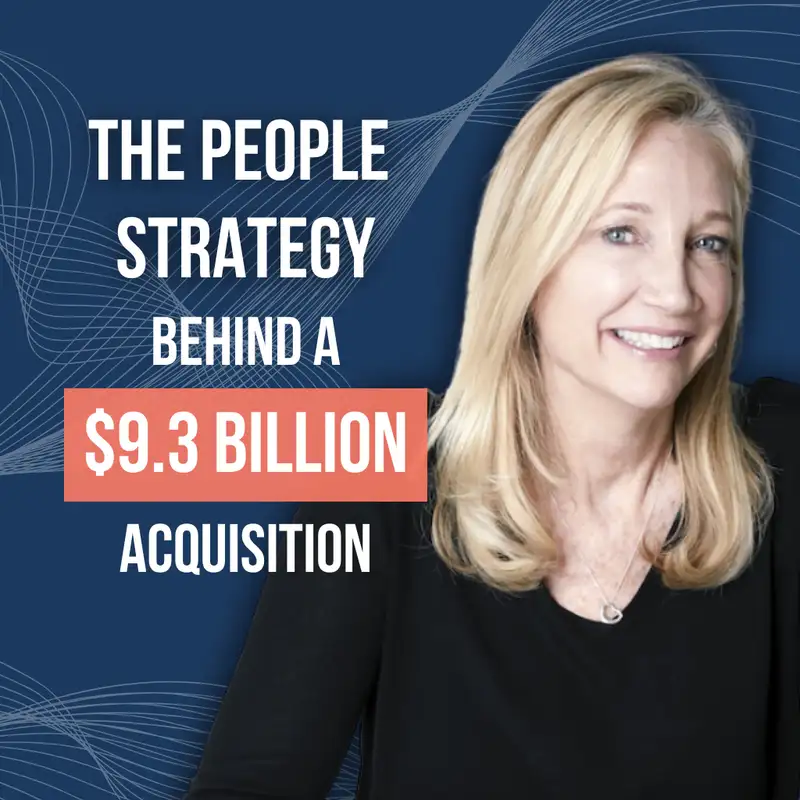
After 45 Acquisitions, These Are the Leadership Red Flags She Never Ignores | Marty Reaume
speaker-0 (00:00.374)
Wonderful CEOs will come to me and go, I don't know what I'm doing. I need this help. I'm like, I love that answer. We're gonna find someone who's got fifteen years experience, you have three. Are you okay with that? I can't wait for that. Is is a great answer.
speaker-1 (00:14.968)
45 acquisitions should make you dangerous in a boardroom. You know where the bodies are buried, you know which people decisions will break the deal before the numbers ever show it. But here's the problem. Seeing it doesn't mean anyone's going to listen.
Marty has spent her career calling these shots early and then watching from inside the room as some of them get ignored anyways. She's a four-times chief people officer, first at NetSuite through its 9.3 billion sale to Oracle, then Fitbit, then Twilio. Now she sits on public company boards where the stakes are higher and the consequences of getting talent decisions wrong are impossible to hide.
Today, she pulls back the curtain on what a people problem really looks like before it hits the numbers and what it costs when the one person who can see it coming can't get the room to act. So welcome to People Multiple. I am Jia Ganesh. Here we unpack how talent decisions act as leading indicators of enterprise value, shaping whether companies scale with strength or stall under pressure. Let's dive in.
speaker-1 (01:24.354)
Marty, welcome to the People Multiple podcast.
speaker-0 (01:27.276)
Thank you for having me. I'm excited to be here.
speaker-1 (01:30.636)
Lovely. I love this fact about you. You know, I heard that you go on sailing trips to exotic destinations like Tonga and Sicily. And I also learned that you love cookbooks. I want to know so much more about it. Tell us more. Do you just c collect the cookbooks or do you cook out of them? Tell us about a dish that's been the most memorable for you from that cookbook. We'll start there and then I'll jump to the sailing part of it as well.
speaker-0 (01:57.742)
Sure. I have a daughter who's a a registered dietitian. and she was a high performing athlete for a lot of her life. So through that period, we just kind of started to understand food as fuel and how to power your body. And that's where it all started. And then she went from that to becoming a dietitian. So it hasn't eased up. If anything you know, we've gone deeper into it.
So that of course leads you to look for recipes and and how do you incorporate these things and how do you make sure that the things are tasty but nutritious. so I started reading I read cookbooks like people read novels, just to sort of understand how to use spices, how to have different proteins, how to, you know, put things together on complex starches versus that. Anyway, so we've been doing that together for for quite some time.
and I enjoy it. I love it. but then it becomes, you know, everybody comes to my house for every holiday event. My daughter and I are the cooks of the family and the family is twenty five people. So you you get what you ask for, I guess, but it's it's fun.
speaker-1 (03:11.906)
But it's lovely. At least you have somebody to cook with and it sounds like both of you enjoy cooking.
speaker-0 (03:17.164)
We do. I think she's better than me at this point. Like we're not. I just had pancakes with her on the weekend and they were the fluffiest pancakes I've ever had. and they were protein based. Like you never know. You know, you just so I think that's a real skill and I I I keep working on it.
speaker-1 (03:37.11)
Lovely, lovely. is there a dish that's become your most favorite or stable out of the ones that you've made so far?
speaker-0 (03:43.914)
we have this one that's a kind of a I'm trying to learn different cultural elements as well and from travel and just from interest. But I have a Mediterranean dish that's a slow cooked kind of chicken dish that whenever it's my daughter's husband's birthday or whatever, or he's coming home, he travels a lot, we make this dish. So it's kind of a Kev dish for us.
speaker-1 (04:05.848)
So talking of exotic travel locations, sounds like you've been on many a great sailing trip taking you to these locations. So which one has been the most memorable and do you have one coming up?
speaker-0 (04:18.392)
possibly have a Thailand trip coming up in the start of next year. We haven't worked that out yet, but all of them were so spectacular. And I was just I was lucky to be invit I don't know what I'm doing on sailing, so I'm not a sailor. but I was lucky to be invited by people who do know what they're doing. And I was you know, my husband and I were then part of the crew. and it started in Tonga, which was an incredible experience. You feel like you're at the end of the earth and you just
You could just see vast ocean. And it was it was beautiful and spectacular. we went during the high whale season. We wanted to see whales. somewhere between July and October. We went in October and we're so psyched to see all these whales in a there's supposed to be whales all over the place. Like you're bumping into whales. We didn't see one whale. no. But it was it was so beautiful and just
you know, so different than your day to day world. And Sicily and Turkey were, you know, different elements of that. So maybe Tonga's my favorite because it was so unique and it was my first trip.
speaker-1 (05:27.626)
I should put Tonga on my bucket list then. You know, when we went to Hawaii maybe a couple of years ago, it was the end of the whale season, but we got so lucky we saw a whole tongue enjoyed that experience. Yeah.
speaker-0 (05:29.982)
Yeah, it's quite a place.
speaker-0 (05:38.895)
good for you. Yeah, good for you.
speaker-1 (05:45.132)
Well, let's talk about your career, Martyi. You know, it's amazing that you've been building a career that's been primarily Silicon Valley based for more than two decades. W all the while you've stayed in Canada when doing that. What does that distance of being in Canada give you or maybe cost you while you're part of the Silicon Valley companies?
speaker-0 (06:08.182)
Gives you a lot of air miles, that's for sure. but actually for part of it, I did move to San Francisco. so for about six years I lived there, but the rest of the time I was traveling there or or around the country. It really, for me as a Canadian, and this is 2005 when I had my first CPO role in Silicon Valley, really gave me the opportunity that I I couldn't
quite have in Canada at that time. Gave me a career that I just I just wouldn't have there and and much more opportunity than our than our ecosystem was building at the time, our ecosystem in Canada. so it gave me access to incredible people and talent and ideas and intelligence, risk taking, kind of a go for it mentality and just incredible learning. Canada is has since developed
you know significantly since then and there's a lot more opportunity but 2005 I was just honored to be selected you know to to be able to participate in Silicon Valley experience. Terms of cost, distance, time, airplane time, some separate my family stayed in Canada and I went to I had a condo in the US but we made it work.
You know, we took the best from both places. My daughter was a little bit older, so she was in later high school and then university. So she was away from us anyway. Yeah. so we really used the opportunity to meet in San Francisco and to do things together. And I think it actually brought us together a lot more on off times or weekends or vacations than perhaps if we were all just in Canada.
speaker-1 (08:00.15)
Yeah, I love that. I love that perspective and that opportunity you had. was NetSuite your first opportunity in the Silicon Valley?
speaker-0 (08:07.85)
It was, yes. It was okay. I started in Canada and I reported to a head of HR in San Mateo, but she left within six months. And I was talking to Herbots, whom I didn't really know that well because I was in Canada. And I said, Don't worry, we'll don't worry, we'll figure it out. I'll help you find a new head or and he said, No, I'm gonna I'm gonna see what you're like because he didn't know me. So he he sort of sought
feedback from all of my clients in Canada and and sort of he said I'll circle back. so he circled back and he said, No, you you sound like you could we don't care where you are. You sound like you're ready and you can run this. And I just thought that was be way before COVID and doing remotely and and I was just so amazed that they were so open to wherever talent was and they didn't make it work. So that's how it started.
speaker-1 (09:00.76)
That's an amazing talent bet they placed and that really panned out well.
speaker-0 (09:05.654)
It did, yes.
speaker-1 (09:08.034)
So this was a fascinating story when I came across it, which is that when you were at NetSuite for you, I believe you were there at nine for nine years. And at that time, NetSuite was selling cloud ERP to enterprise customers who still believed that software had to live on premise at that point in time, right? So I'm curious, what kind of hires did you make to drive adoption for something that the market hadn't even decided is going to survive or decide to trust, you know? And how did that early talent
bet compound when the cat category was eventually built later.
speaker-0 (09:44.63)
Yeah, the the early hires that were most impactful were inside sales talent. so we were all moving from outside, on premise, you know, traveling around, meeting customers, customer relationship, that kind of thing, to now you had to sell something that people couldn't see or touch or feel. It wasn't an on premise over the phone or in a Zoom call. very different skill set.
so it is inside sales skills that we had to hire, but it's also almost like an an educator, a translator. somebody that can build trust. This is the way we used to do it. This is where we're going. And I'd like to help you get there. so that educator, that translator was really important. You could call it salespeople or inside sales or whatever, but for me it was a
Like we've gotta build trust in the new way of doing things. We like we didn't even know what cloud was, you know, we didn't know what SAS was. So now that we're in it, we understand it, but nobody out there, you know, our customers don't. So how do we build that trust? How do we educate? How do we give them a vision of where this is going? But they trust the answer.
speaker-1 (11:08.6)
How did you enable those salespeople? Because it was a new product for them too, you know, it's like selling vaporware almost at that point. how did did you all put in any specific efforts to enable them to be successful in a time when category creation was forefront for everybody at the organization?
speaker-0 (11:27.394)
Yeah. We we certainly did. We did a number of things. We hired great leaders. even if they didn't have the skill set, a great leader can do a lot because they're a great leader. We revamped our interview process to assess for inside capabilities and that educator and translator. But taking a step back, we identified, we had the sales team that we had. We all moved from outside to inside real fast. We had the sales team that we had.
Now who was making the switch? Who was able to become that inside sales reps educator, translator? And who wasn't? And now what was the differential? what were those skills that the the people that could could switch had that perhaps we had to start to really develop in other folks? so we spent a lot of time there. Like, why was this person successful and this person wasn't?
before you sort of okay, we gotta we figured out we before you sort of throw out the other talent, how do we develop that? How do we transfer the DNA? How do we maybe keep as much of our sales team as we possibly can? They already know the product, they know the company, they wanna be here. How do we actually try and develop that? So we also had training programs where you're sort of transferring the DNA.
where our top sales reps were going, Hey, this is how I went about the deal. Like they were teaching the other sales reps and we used that. We had a really, really strong enablement program by the time we were done.
speaker-1 (13:07.522)
Well, it panned off. Great. You know, while you were at Net Suite, you dealt with forty five to fifty acquisitions. I'm curious, what was the signal you learned to look at first? The thing that tells you that a deal has a people problem that will actually outlast the integration? How did you did you get better at identifying that as every acquisition went through?
speaker-0 (13:29.836)
Yeah, I don't think it was it wasn't forty five to fifty well in that suite. I think it was sort of across my career, so I don't wanna overestimate that. But Okay I did learn to pressure test a few things early on, me and and my team and my colleagues on the executive team. We spent time looking for people integration risks. well ahead of the integration and well ahead of signing.
anything, right? So we we spent time up front and you know, you can read in about it, but most of and A goes awry on the integration. but how come? You know, how it was so we had to back it up a little bit. So what did we look for? Trying to determine things from the other side, from the company the target company or whatever. Understanding a sense of from them, why did people join? Why did people stay with them?
How did they make decisions? That was a huge one. What makes their culture unique? And we're trying to sort of figure out is there any hidden culture? Is there any talent risk? Asking a founder, what happens if you leave? You know, to the founder? And a red flag would be, we'll be fine. We'll all be it'll be fine. Or you get an answer like, here's who drives product, here's who drives engineering, here's who drives customer experience, here's who's a culture carrier.
That's the that's the difference, right? well, I'll be fine. Or they can point you to where we need to sp spend time, get people excited, get people on board. Is there a risk of founder dependency that the founder is underestimating? Like does the sort of revolve around them and they don't really know it. They don't really see it, but we had to sort of suss that out and understanding it. Asking a founder.
Who who are the twenty people you can't lose? Hmm. And getting their answer right then and there. Not like, I'll go check for my team and blah, we'll pull it back to you. No, no, no. They know who the twenty people are and they can tell you right then and there. And if they can't, that's a red flag. and especially if they say something like, Everybody's important, that's an easy answer. It's usually not right. So I I look for those kinds of
speaker-0 (15:54.804)
Automatic responses to some pretty some pretty deep questions. You can also look at things like do employee turnover stories add up? You know, when you ask one executive and you ask another executive, are they just sort of they're sweeping them away, like it's not a problem or whatever, or are there patterns there, hidden patterns, or the stories just don't know they they made up their own answer to the story and they don't align to what
Is any one of them actually right? Like we don't we don't know what the what the story is. so there's there's lots of ways, but I think you have to get really skilled at asking the right people and some questions and then knowing what a flag is in the answer. you can also take the executive team, right, and ask them what are the company's top three priorities? Mm-hmm. Hopefully you get similar answers, right? Yes. Ask them individually.
speaker-1 (16:51.518)
Ha ha.
speaker-0 (16:53.684)
What makes the culture special and unique? Hopefully you get something similar. what are the biggest risks right now? Again, hopefully you you know you can see the alignment or you can't, and those are red flags.
speaker-1 (17:05.975)
So was there was there one that helped more than the other? You know, you listed a whole bunch of aspects to uncover, but was there one that was like a deal breaker compared to the rest?
speaker-0 (17:19.266)
Yeah, I don't think I don't think you can go on one, but I think you can go on, you know, a combination. Like you can go on three or four. 'cause that will lead you to to other things. But if you just asked one, that could just be a difference in how you see things and how they see things or perception. Like that's not enough. That's enough, not enough for me to go, Well, we've got a red hair or a red flag here. Not a red hair. So, but I think it's a combination of, you know
four or three or four really broad questions that then lead you into more discovery. I think those can be the the foundation of a of a good check.
speaker-1 (17:58.766)
And when you uncovered a red flag, was that did that weigh into the deal at all, or was that kind of swept under the feet?
speaker-0 (18:09.504)
It depends. It depends on what the red flag was. and if you how far we could push it and that led you to other things to sort of dive into. So if I came back with a whole bunch of stuff and said, Look, I have concerns here, here, here, and here, I I need the whole team to help me figure out these concerns, we may be fine, but I don't feel comfortable unless we're digging in further on these areas.
And after doing a couple of a couple of and A's, not very well. I mean, we you know, we all started and we didn't know what we were doing. And then we did we'd do another one and we sort of started to get better at it. And, you know, by the time you're at twenty, you're really good at this. You know, you're you're really good. You've got a playbook and you know what to look for. So it was easier to say to my colleagues, I've got an issue, they would turn around and go, Okay, what is it? How do we get through it? Because we trusted together, right?
speaker-1 (19:09.152)
You and your CEO were profiled in Fortune magazine as a dream team partnership. Was there a decision that you remember from that time that turned out to be the most consequential when you both were running as a team there?
speaker-0 (19:25.946)
yes, that was a series of articles that Fortune was doing. not on our organization. They were just doing, okay, the CEO plus CRO, the CEO plus CEO. They were just doing a CEO and their dream team. and when they got to CEO and CPO, they chose me and my CEO. and I think it was sort of back to what we were talking about earlier. A lot of our customers were asking us, how are you doing this?
How are you building your sales team? And so quickly and so effectively because we had to go out and sell to these people. So they were experiencing our sales team. some of those folks would come back to us, like our customers, they would come back to the CFO or the CEO and say, tell me how you're building your sales team. And for me and the CEO, we sort of figured out all those things. Like we've got to figure out how to flip the talent from outside to inside.
we've got to figure out how to have a really good enablement team for new onboarding sales team members, but also current ones that need need the the development. And along the way, we also implemented psychometric assessments. okay. So we could really sort of understand how to develop team, how to develop a a a teammate, how to interview, how to assess talent, how to
build teams, how to pair incoming talent with with the most productive leadership profile for their skill set. So that was two thousand and eight or nine, I think we started to do all of that. Which the you know, psychometric assessments are used quite often right now. But then it was it was a little bit cutting edge and some people thought they were horoscope like and you know they didn't have the credibility they have now.
But that really helped us a lot and it took off in the organization. So it took off in sales, eventually went to implementation, eventually went to support. And then the big coup was eventually we got to development. Even the developers were so I think that sort of caught the attention of the Fortune team, and then they decided to interview myself and my our CEO.
speaker-1 (21:49.602)
That is so cool. when Oracle acquired Net Suite for I'm for I believe about nine point three billion, I think. You had been building the people function there for most of the decade. Did you feel like the people decisions you made at that time have a role in what the company was ultimately worth at the time of the transaction?
speaker-0 (22:10.082)
Yeah, I don't want to overblow anything, but you're talking to a career human capital person. So I'm gonna say yes. Like the short answer is yes. Oracle was acquiring a really strong team. Strong in sales, strong in implementation, strong in support, strong development. The company was successful on its own, and this was apparent. So for Oracle, it was do we build our own mid-size application? Do we build our own team?
Or do we go and get Net Suite and just, you know, bring them into the fold? So Larry was also Larry Ellison was also a a huge investor in Net Suite, so it all made sense.
speaker-1 (22:51.064)
So then after NetSuite, you went to Fitbit. And at Fitbit, it sounds like when you joined, the challenge wasn't that the wasn't the product itself, it was just that Apple had entered the market at the same time. How did you keep a people function moving when the external narrative about the company is not generally tend trending positive necessarily?
speaker-0 (23:15.148)
Yeah, we were with Little Fitbit up against the Giants, right? Yeah. So it was tough. It was actually very tough. Apple could always out Apple us. there were bigger pockets, bigger brand. They won the war for talent. You know, they could always pay more than we could. So we had to figure out two things. And one was figure out our strategic advantage as an employer. Like why come here as opposed to Apple? What could we offer you?
And we spent a long, a lot of time figuring that out and testing the market and testing people and hires and that sort of thing. And then how are we different as a product? Who's our target audience versus their tar target audience? So what's our two things? What was our talent brand? And then who who would come here and thrive that may not thrive at Apple? And then to customers, if you wanted a simpler watch, if you wanted to make sure you were to
sort of tracking these things, but you were a little overwhelmed by the whole Apple offering. Now that was a good way in. We had different applications as well. There were some I was gonna say gentlemen, but women and gentlemen that they liked their watch. They liked their whole watch or whatever they were wearing and they didn't wear one of these things. So we had necklaces and pendants and you could put a little pebble in your pocket and it would track everything. Like you didn't have to wear it as a watch.
speaker-1 (24:44.372)
Really? I didn't know. I was not aware Fitbit had those variations.
speaker-0 (24:47.682)
Yeah. And we so we partnered with Tori Birch and she designed these beautiful necklaces and the the pebble was inside the necklace. so we had different offerings like that. and we were also less expensive. Yes. so we just targeted all those things. if you're interested in this and you know, the price point is this, and we just figured out how to differentiate ourselves from Apple in terms of product, but also in terms of
If you wanna come here and design a watch, come here and design the whole watch. If you wanna design a tiny little piece of a watch, go to Apple.
speaker-1 (25:25.79)
That's a great employee value proposition. Yes.
speaker-0 (25:28.898)
Yeah, but here you've got it cover to cover. and that was attractive to a certain type of UX, UI engineer. we were able to to attract some really great talent.
speaker-1 (25:42.508)
I still wear a Fitbit today. Yeah. I don't wear an Apple Watch. I really like the simplicity of the Fitbit. It gives me the exact information I need. I don't need anything more fancy than that.
speaker-0 (25:53.804)
Yeah. So you are there you go. You're our target customer.
speaker-1 (25:56.78)
There you go, yes. I've replaced quite a few, but I still continue to be loyal to Fitbit.
speaker-0 (26:02.434)
Me too.
speaker-1 (26:04.23)
Marty, you know, based on your extensive acquisition experience, I feel like you've probab you probably had developed a way to do cultural diligence. And when you moved from Fitbit and went to Twilio, and when Twilio acquired SendGrid for approximately two billion dollars, did you use some of the lessons from your prior acquisitions or did you use the same playbook? And did anything stick or blow up because of that? Love to know because that is a huge acquisition.
speaker-0 (26:33.422)
We did have a playbook by then and I was very fortunate that some of the team that I worked with, my team and other others at Netswe came over to Fitbit. and that so we did more. We did more acquisitions together there. And then when I moved to Twilio, I brought that same team over to Twilio.
So we didn't have to learn anew. Like we all we all knew what was going on and we all had the benefit of such wonderful experience. So we brought a lot of that together with the team. and I was so fortunate because the team was so amazing. Now, having said that, every acquisition is a little different. so we couldn't just press play and go. We certainly had to understand the nuances, but having that foundation was incredibly helpful.
But Tullio and Sengrid, for instance, were two public companies that we were acqua right. I'd never done that before. Hadn't done it public to public. So there was new learning there. There was new learning from my team. But the foundational base was so strong that we could do that. We could learn and and know what the next watch out was. And it was also good for us to have something new in an acquisition so it didn't become routine.
speaker-1 (27:51.202)
Yeah, yeah. I love that. You I identified something which most people would not have brought up. The fact that you had built that foundation with the team that had gone through the same situation so many times and come through it successfully every single time. I think that makes a big difference. We can't underestimate that team dynamic that played into this cent grid acquisition as well.
speaker-0 (28:14.37)
Yeah, for sure. I was so grateful. Like I had incredible people on the operations side that we just kicked into gear, right? We just knew what to do. And and some of it, a lot of it, now that I'm watching acquisitions elsewhere and I'm not part of them. some of it is just how you treat people, how you treat the process, how welcoming you are, you know, what day one looks like when you flip that switch. What does that look like for the people that are your
you know, you're partnering up with no. I think those things are so important.
speaker-1 (28:48.864)
And did you and your team spend time through all that as well?
speaker-0 (28:52.396)
Day one was a big day. Like we had, you know. A hundred days from day one, then ninety eight days from day one. We had a yeah. We had a countdown. And our goal was to have if we were the acquirer, our goal was to have people want to be there. They're excited to join Fitbit. They can't wait to join Twilio. and it's not a hassle of systems and passwords and logins that go awry, right? Like be
really, really thoughtful about all of those things and make it as easy and welcoming a and also just they're excited about the next five years. So that was that was always a goal.
speaker-1 (29:32.406)
I love that. When you were with Twilio, it sounds like Jeff Lawson had built Twilio around developers who are customers, not employees. And as chief people officer, what do you how do you come up with a talent strategy when the most important people to the business model are living outside the organization?
speaker-0 (29:50.474)
Yeah, I th I thought about this question. I just thought I think it's a bit of a universal situation. Like Net Suite was built around customers needing ERP. It wasn't built around our class, right? The employees or Oracle or SAP or Sage or whomever. it was just so pronounced at Twilio. I think that's why you're picking up on that. Like we have big boards on the one on one that said Twilio, ask your developer. Yeah. Right? I don't I remember
driving by those. it was so pronounced and focused around the developer community at Twilio. So I think there was a little bit more there. So the challenge at Twilio, especially from an employer side, was around talent brand to try and broaden out the awareness of what we did, who we were as an employer, beyond the developer community, and actively work towards this. So it was almost like a
An employer brand, a talent brand, you know, partnering really closely with a fantastic marketing team. We held open houses. We worked on purposely diversifying our talent pool. We sponsored community programs, like here's Twilio, here's what we do. Like people who were outside of developers at the time didn't have a clue what Twilio did. And I have to like when I they invited me for an interview, I'm like, I don't even know what you do.
speaker-1 (30:59.651)
Wow.
speaker-0 (31:16.122)
so I had to do my own, but I think that was the sort of the general population. So we had to overcome that. Here's what we do, here's what we power. Do you use this? Because Twilio's the power behind that, right? If you use an Uber, Twilio's behind there. So we had all these different ways of this is what we are, both as a product and as an employer. We had bring a friend to Twilio recruiting events.
speaker-1 (31:24.93)
Yeah.
speaker-0 (31:43.968)
Houses, dinner nights, you know, we did we did all of those things. Kind of a ground up grassroots marketing of Twilio as an employer. but very purposeful there. As opposed to Fitbit, everybody saw the commercials, right? Everybody knew what a Fitbit was. That wasn't the same work. it was then deciding, you know, who's gonna thrive at Fitbit. And Twilio is like explaining what we did.
speaker-1 (32:11.406)
I love one of the tidbits you'd shared earlier, which was around the part of your recruiting process. I I'd I'd love for you to share what you made every person do at Twilio as part of the recruiting process in terms of developing the
speaker-0 (32:26.314)
I think I shared that at the conference, right? Yes. So every person who joined Twilio was assigned a developer. Every single person. Didn't matter what didn't matter what function you were in. You were assigned to a developer. It was wonderful. We had this whole community team. So we were assigned to one of them. And our goal was we had to we had to build an API. It could be anything. It could be something that helps you in your
speaker-1 (32:37.772)
Perspective of raw, right?
speaker-0 (32:55.16)
Personal life, it could be something at work, didn't care what it was, but you had to build one, understand how to build one. The engineers were so helpful. So they took us through the process, they whiteboarded and this is every single person who on board.
speaker-1 (33:11.512)
Can't believe they did that with every single person.
speaker-0 (33:14.366)
my gosh. Different points. We were hiring like somewhere between three and six hundred people of order. and that went up to eight hundred. Like there were a lot of people. and so they ultimately you build your API. you had to have it working well. And then there was this thing called Wednesday night dinner, where you it's totally a sponsored dinner for anyone. It was staying late, it wasn't staying like it was just a way to bring the community together. But at those Wednesday night dinners,
It was up to you to go and demo your API. and you hope that it works and that everything goes well. But y the engineer usually came with you in case you ran into some issues. But if you did those things, if you built an API, demoed it, and all worked well, then you were given a red Twilio jacket. and that was a thing. You know, you you'd see people walking around with a red jacket and go, they've built their A API.
speaker-1 (34:13.07)
No.
speaker-0 (34:14.786)
So it wasn't just a swag thing that was handed out. It was earned. yeah. And it was a real sort of it felt great. I got my jacket and like I actually built an API. I I earned this. I mean that
speaker-1 (34:27.585)
So cool that people maybe there are people that don't even know what an API is, right? Not you can't assume everybody knows what an API is, but it's so cool to come and to be learning what an API is and then building one and then showcasing it to the community and earning a not let's call it a reward, a kind of a recognition thing. I think that's an amazing, amazing way to welcome somebody to the team and making them understand that this is what we are selling to customers.
speaker-0 (34:39.714)
Exactly.
speaker-0 (34:53.154)
Yeah. Yeah. And I I built mine that was work related. it was kind of in the height of I'd say n an employees market, right? Like they they had five job offers whenever they wanted them. So myself included, like a couple of times I was interviewing and I just thought, okay, who who's the who's the recruiter? Who's the head of HR? Who's the CEO that I'm meeting? Like there was just all this where is it? What building and what floor am I going to? And
Most of the time you're at a full time job and then you've got to go to an interview, right? And I thought, wouldn't it be h great? Like if you have a dentist appointment, I used to have this little text pop up and they'd say, Your dentist appointment's at three o'clock or whatever. Like, wouldn't it be great if we could build something that says for a candidate, looking forward to seeing you tomorrow at three PM? You'll be meeting Marty on the tenth floor. That's what we built.
So that's what my API was. So that every candidate we could send out a little reminder like that. And they didn't have to look through all their stuff and their notes. And but I just thought, wouldn't that be helpful? 'Cause it would have been for me when I was in
speaker-1 (36:00.824)
See, you thought about it from the shoes of the person that you were supporting. So that's a super cool app API that you built. fast forward to d today when all of us get ten thousand pings for ten thousand reminders for that same dentist appointment, right? It's a different world we live in now.
speaker-0 (36:16.728)
Yeah, exactly.
speaker-1 (36:18.936)
So after your stint as an operator, you've moved on and now become like an advisor, board member, you know, and you I believe mentor and advise many other operators. So I think this is a story you mentioned, which is that you currently are on a board of a public company and there was an acquisition that went through and turned out to be close to the worst possible piece of acquisition you've seen.
So obviously without naming the company, can you walk us through what you saw and what you pushed for?
speaker-0 (36:55.764)
it was fairly recent. I don't think, in hindsight now, right? I don't think there was a full cultural and talent assessment completed. I'm not sure, but I don't think there was. And if there were concerns raised by the people team, I don't think those were really fully digested or understood or noted or fully discussed, like whatever the right term is.
I don't think it the concerns were given the appropriate concentration or or airtime even. There were definitely s style issues, but these for me are not deal breakers. Like there's lots of mature companies that ingest startups, right? That very different cultures, but i it can work. These were more leadership team style issues, company culture issues, what was rewarded.
what was expected, what was discouraged. and sort of like later, things that were discouraged at one company were actually badges of honor at another company. at the other company, right? So those are hard to overcome. Things like full transparency as opposed to command and control. you could do whatever you want as a company, but trying to bring those together is rocky. How decisions were made.
And I know I know that. you know, that one company was super quick and just like off the s you know, very off the cuff. And they had the eighty twenty rule where the the other company was like, nope, full homework, you know, we'll do a hundred percent. And it just felt like it felt like an impossible environment to the other to the other guy. So decision making, you asked me that earlier is a red flag. That's a huge red flag. So unfortunately this was
This was probed at the time, probably not enough, if I was to be honest. and then found out afterwards that yeah, these were all real issues.
speaker-1 (39:06.358)
and it sounds like the CEO was almost irritated when asked for a cultural assessment. What was he so resist he or she res so resistant about?
speaker-0 (39:16.824)
Takes time. not a lot of time. And for me, it's always been useful time, but well, you know, what will this do? It's an investment of time. What will it actually give us? And then I'd, you know, sort of talk about what it well, we already know this information from interacting with the team. We're good. it was like another thing in in the integration or in the due diligence process. And just from my background.
Yeah, it's another thing and it's it should be number one or two on your list. It shouldn't be at the bottom and going, it's another thing. It you know, it depends on where you come from and your experience and maybe past integrations and acquisitions went perfectly fine without this. So that's their experience. I just don't think it's I can't think of a time when it's gonna be wasted. Wasted time or
speaker-1 (40:10.594)
You always learn something that could really help you, right?
speaker-0 (40:14.732)
Yeah, even if it's not then, i i it could be something you learn that you then remember later. And it's it's it's useful, yeah.
speaker-1 (40:22.142)
Right.
As always. Marty, now that you've crossed over, right? Meaning you're no longer an operator, what has changed in how you see people decisions when you're not the one making them and you're far removed from inside the company and you're evaluating the company and its operations from the outside?
speaker-0 (40:43.758)
As a CPO, I was just I was coaching somebody last week and we had this discussion. She was trying to determine if she wanted to stay where she was or move to the CPO role. And she was kind of a VP head of HR. And we had this discussion and I think it's clarifying. But as a CPO, I tended to see talent decisions across the organization and how they affected the business. And I think as a head of HR, VP, S VP of HR as the
expert, the SME on the people function. Whereas the CPO or CHRO is a member of the executive team driving the business, driving the future, who happens to have a deep expertise on the human capital side. Like other members happen to have a deep ex expertise in finance or implementation or whatever. so at the board level, I feel like it's the CPO skills are just they're supercharged.
So you get lifted up a a little bit more, far less about individual things being done in the HR realm. I'll caveat that with assuming there's an HRT, right? Assuming a full blown HRT. and far more about the future of the business, where and how to invest. And lots of this comes with talent decisions, of course. Hmm.
speaker-1 (42:05.698)
You at Sampavirance, you advise portfolio companies on talent decisions. What kind of decisions do you see them trip over the most?
speaker-0 (42:15.15)
simper Varens and I I do a lot of work at Mars as well. I see them I even when I was a CPO, kind of the same the same discussions I feel like I'm having, but it looks like the wrong person is being looked at, the wrong skill set is being looked at, maybe for honorable reasons. you know, they've been there a long time, they were there in the beginning, they've been my rock.
But it's they're not the go forward skill set. And this will come back to haunt them and it haunted us when we made the wrong decision. but you know, person's been a teammate for so many years, they deserve this, blah, blah, blah. It's not about deserving this, it's about the future needs of of the company, right? so I see that one a lot. You see founders who might stay too long. You see founders who that might.
not stay long enough and too much of the company revolves around them. You see poor promotion criteria sort of along the same lines, like they deserve it. They've been here long not really. You know, what does this role need and do they have it? Like step step away from the names and the legacy and whatever. Here's the role, do they have you know, what's the skill set? Now does that person have it? And then something like the has it
hesitancy to hire someone much more experienced, maybe much more experienced than you. That's that's a real signal to me. really mature. Yeah, wonderful CEOs will come to me and go, I don't know what I'm doing. I need this help. And like, I love that answer. Yeah. We're gonna find someone who's got fifteen years experience. You have three, are you okay with that? Yeah. I can't wait for that. Is is a great answer.
Hesitancy is it's it's a little more difficult to to get the best outcome.
speaker-1 (44:17.922)
That is interesting. one of our previous guests, Natalie, brought the same perspective around stage appropriate fit, right? And it's fascinating to see that most of us are experiencing the same tripping wires, which is not being able to hire the right person for the right stage of the company at the right time.
speaker-0 (44:39.298)
Yeah. And it's it's very common. It's not like it we're people. It's human nature, I think. and some people just have a a learning velocity that is a little bit faster and they they they catch on to it. And like learning, you know, attachment. There's yes all those things that that come into play. but I was talking to another person I was coaching and I I said, What is the the answer that you love coming from
speaker-1 (44:53.998)
і го
speaker-0 (45:08.888)
A CEO or a founder when you're working with them. He's also coaching. And he gave me his. And I said, You know what my favorite answer is? My favorite answer is, I don't know. I love it when they answer, I don't know. I'm like, I can work with that. Yeah. they're not trying to come up with an answer because they're the CEO, they should know the answer. Like sometimes you just don't know the answer. And being able to say, Yeah, I don't know. We should, we should find that out one time.
speaker-1 (45:18.222)
I don't know yeah.
speaker-1 (45:29.367)
Yeah.
speaker-1 (45:34.508)
And there's nothing nothing wrong in a C or not knowing something. Yeah. I think you and I briefly exchanged an email about this, Madi, which is, you know, it's about having a HR person in place early enough. You referenced a senior person that I'd love for you to share about the article who talked about the importance of having a senior leader. And so I'm curious about what the actual cost that you've seen in a company when they've not had a
HR person in place at the right time.
speaker-0 (46:07.32)
Well, first, like I think it was who would your HR person be in a series A, right? Like who's your first player? Which is what we were talking about earlier. and you know, my answer is I hope it's not a recruiter. I hope we're flat. You know, no no shade given to recruiters. I've worked with the amazing recruiters and that have taught me a ton of things. But if that's your first recruiter
or sorry, if that's your verse position, I think you're really missing out. if you hire whatever the title is, you know, whatever the title is, VP of HR, head of HR, head of co-ops, you know, whatever it it may be, they will be able to hire two. They will be able to get the right talent. They will be able to understand the business to know what the right talent looks like. and
Do a whole bunch of other things too. So you know, that's that's how I hope series A B companies are are are thinking. and there was a an article that I read a long time ago and I was trying to find it for you. and me, I couldn't I couldn't find it. but a a reporter was asking Mark Andreessen from Andressen Horowitz what the startups do.
speaker-1 (47:05.462)
Yes.
speaker-0 (47:32.658)
continuously incorrect what he sees just happening all the time over and over again. And and his answer was they don't hire an HR person. And I think he said senior, experienced HR person, fast enough. it amazed me because out of all the things I'm sure he sees and and and Dreessen has witnessed and all the people, companies he's been involved, that was his answer.
speaker-1 (47:59.862)
Yeah, I I love that it's being recognized by s somebody as you know, as a stalwart like Anderson. I'm moving us to the last section of our session here, Marty. I could talk to you forever, but I do want you to go back to your family. So moving us to the rapid fire question section, go with your first instinct. Don't need to overthink if you can. after all the acquisitions you've been to, fifty acquisitions, what is the cultural red flag that you can spot?
In the first few minutes.
speaker-0 (48:31.694)
I'd say speed of execution, decision making that goes hand in hand with that. And I'm gonna throw in integrity boundaries as well. So those are the areas of probe and you can just you can you know, you just get that whoops, we've got more to look into here, you know, after you get
speaker-1 (48:48.694)
Even integrity you think is sus you is possible to suss out in the first few minutes?
speaker-0 (48:54.392)
Sure, it's, you know, g give a a situation, could be financial, fiducial, whatever. Like, how do you approach this? And you know, how comfortable are you with this, this, and this? And, you know, some organizations will go, we would be up all night. Like that and you know, others will go like, Yeah, we're okay. We'll we'll go around it. Like it's fine. I think that tells you a lot.
speaker-1 (49:20.948)
Does. what is a boardroom skill that you think every chief people officer underestimates?
speaker-0 (49:28.494)
the ability to translate people issues into business outcomes. And we, you know, you do that as a CPO. Hopefully you're doing that as a C CPO. But you know, what does this actually mean for growth, execution, risk, shareholder value? That translation is invaluable.
speaker-1 (49:53.528)
How do you think upcoming CPOs can build that skill set?
speaker-0 (50:00.106)
by have being really close to their business partners, and I don't mean their HR business partners, I mean their other executives. being really close to them, learning from them. I always sort of went in with you know, I can help you with this, and they're so relieved because I don't want to do it. right. So I can I earn their trust and I help them with this, and it's something that's not hard for me, but it's a pain for them. so
We get it done and then I'm just, you know, I'm around them a little bit more. I'm in involved in their meetings. I sit in on their meetings. I bring in their salesperson to our meetings to say, Hey, tell us how you close that deal. and my team would learn so much from that. I'd wait a little while, but if I knew that a t a deal got blown, I'd wait a while because there's there's wound licking there, right? There's a period of trying to get over it. But then fill it in that
bring in that salesperson and go, hey, tell us what went wrong. Tell us what you learned from that. But I'd bring those folks into my meetings. And I wasn't necessarily the head of go-to-market or a leader's salesperson, right? Like, teach us. and I think being exposed to those things constantly, like not once, but a lot. It's just how you do, how you work together, you you really develop a critical eye for if this
What's the impact? You know, if if we do this, if we don't move that person, if we give that role to this person, what does that do for growth, expansion, risk? Well, like whatever it is. But making those connections is super easy if you're really embedded, not super easy, it's never super easy, easier if you're really embedded in the business.
speaker-1 (51:52.066)
You develop that muscle right after some time.
speaker-0 (51:54.018)
Yes. Yeah.
speaker-1 (51:56.399)
most overrated thing in the people function right now.
speaker-0 (52:00.334)
I may get things thrown at me for this. I'm gonna say traditional employee engagement scores.
speaker-1 (52:12.656)
that yes.
speaker-0 (52:15.17)
When you think about all the work that goes into that, how static it is, point in time, do you get honest answers? just the whole process kind of measures if people are happy, maybe, if they were honest. Does that mean they're committed? Does that mean they're accountable? Does that mean they're growing? Does that mean they're ex executing? will they say they're learning? Will they say they're performing well? Are they gonna say they're performing well? Like we don't even ask them that on a on a
and employee engagement. are customers benefiting from us? We don't ask that on a traditional and then just the, you know, is it once a year, is it twice a year? and you when you think about what does a board really care about? What like what do they care about that? Regrettable turnover of top performance for sure, leadership bench strength, successor readiness, hiring quality, manager effectiveness for sure.
productivity per employee, employee trust and leadership, engagement scores. maybe if it was forty per percent or so, I don't know. but I just think there's a lot of effort in there and not a lot of actionable, true we trust this. We're gonna do something because of this. It'll change our company that you can get out of these engagement things.
speaker-1 (53:41.646)
I love that. I think several of our other guests have also brought up that same sentiment around So you won't get anything thrown at you. Marty, last rapid fire question, which is what is one thing investors should be reading in a management team that they are most often not paying attention to?
speaker-0 (53:46.178)
Good.
speaker-0 (54:00.728)
That's such a great question. I think something like pay less attention to the management team's confidence and more attention to the management team's learning velocity. Like how quickly does the team realize it's wrong and make an adjustment? And say things like like we talked about earlier, I don't know, or we got that one wrong, or you know, we learned this six months too late.
and here's how we're gonna change that going going forward. or here's what we missed. But just the learning velocity, you can have management teams that are very practiced at presentations, but that doesn't mean all of these things behind the scenes are in place. so less attention to their confidence up there with their PowerPoint or deck or whatever. And you have to really get into the the layers below and figure out.
They're learning velocity.
speaker-1 (55:00.276)
I love that insight, Marty. And definitely that's one thing many of us make a mistake, even if it's not just investors and management team, right? Even in a regular recruiting effort, we have that same tendency to be kind of blown away by the confidence of the candidate and we fail to suss out some of the other aspects. So that's a great reminder.
speaker-0 (55:21.678)
No, that's a great parallel. Like you can do that in interviewing as well for sure. Yeah.
speaker-1 (55:27.744)
Last question for today What's the talent decision that most changed a business outcome that you were a part of that maybe no one in the room recognized as a talent decision when it was being made?
speaker-0 (55:39.726)
Yeah, I think are a lot of those that aren't described as a talent decision. I'd say one is the decision about who leads the next phase of growth. this could be sort of swept under operating strategy, restructuring, scaling, transformation. Yes. Any of those decisions, but ultimately it's a people decision. is the founder
staying too long. Like who leads the next period of growth? Is it the best engineer and we promote them to be a leader, but they're not really a leader? Who leads integration after an MA? That's a huge decision. that leader of integration after you saw I that's a huge decision. So who leads the next phase of of growth for an organization, I think is is a big one.
speaker-1 (56:33.474)
I think in today's economy that question is all about who leads the AI transformation, right? That's what everybody's battling about. Is it the s chief people officer? Is it the chief financial officer? Is it the CEO? So I've seen a lot of debates go trying to answer that question now.
speaker-0 (56:51.682)
Yeah, or it's a combo between CPO and CTO, which, you know, whatever's right is right. But a lot of in my small world, a lot of CTOs are going, No, it's okay, the CPO can do it. Transformation piece is hard. CPOs are like, Okay, yeah, it's mine, I got it. and it's not just it's not change management, right? It's it's transforming how you do work.
speaker-1 (57:04.781)
Ha ha.
speaker-1 (57:09.016)
This one is hot, yeah.
speaker-0 (57:21.122)
Which
speaker-1 (57:21.442)
Exactly. It's a whole redesign, rethinking of how work is getting done completely.
speaker-0 (57:27.554)
Yeah, exactly. So I think you're spot on there with AI.
speaker-1 (57:33.112)
Well, thank you so much for joining me today and sharing some of your amazing experiences with us. I really appreciate your time today.
speaker-0 (57:42.37)
You're welcome, it was a pleasure.
speaker-1 (57:46.296)
Thanks for listening to People Multiple. If you found today's conversation valuable, don't forget to give us a 5-star review and share it with a colleague or fellow investor. And don't forget to follow the show on Apple, Spotify, or wherever you get your podcasts. Follow us on social media using the information on the screen and in the show notes below. This has been a production of the AGN Group. I am Jia Ganesh, and I'll see you next week as we continue to explore how talent shapes multiples.