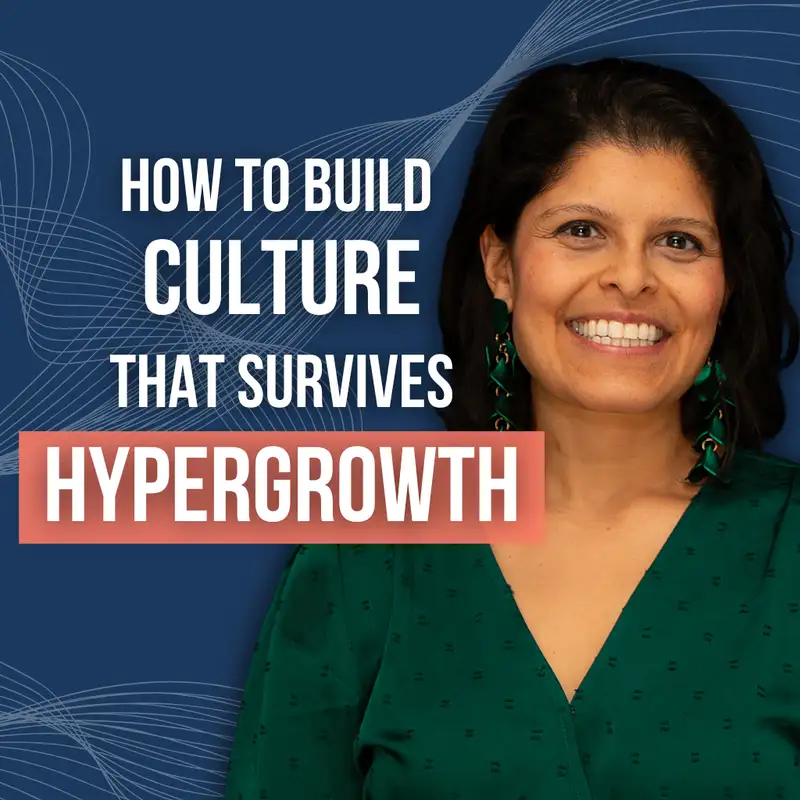
The CEO Wanted a 5-Minute Layoff Call. She Said No. | Payal Maheshwari
speaker-0 (00:00.43)
You tell everyone they're getting laid off, the company's closing, and you hang up the phone. And I called my CEO and said, no, we have not built that kind of company, and we're not gonna end it that way either. People need to know how did we go from this big moment where we had 200 people in New York for the ringing of the bell to a year later, we don't exist? People need to know.
speaker-1 (00:23.502)
Most leaders still treat valuation as a spreadsheet problem and people as an HR problem. Payal Maheshwari's story at MBARC shows those two lines live on the same PL.
Payal is a former Lemon Brothers valuation analyst and people and culture leader who scaled compass through an IPO and let Embarks People Function through its rise and window. In this episode of People Multiple, you'll learn how to read people decisions the way investors read models and how to lead so your next talent call shows up in the multiple your business does. Welcome to People Multiple. My name is Jia Ganesh. Here we unpack how talent decisions act as leading indicators of enterprise value, shaping whether companies scale with strength or stall under pressure.
Drop me a line on LinkedIn to say hello and what you thought of this episode. Let's dive in.
speaker-1 (01:15.394)
Hi, Payal. Welcome to the People Multiple Show. I am so excited to have this conversation with you.
speaker-0 (01:21.04)
my gosh, I'm thrilled to be here. It's so nice to meet you and and finally talk after years of circling around each other.
speaker-1 (01:27.67)
I love it. I love it, Payal. I have to start with this fact that I learned about you. I understand that you're a serious farmer's market person to the extent that that you like to pull over, make a U-turn, carry empty suitcases with you on California trip level of serious.
speaker-0 (01:47.31)
it's a lit it it's a problem. It's probably a little too nutty. I have I cannot tell you how many former colleagues have had to schlep to farmers markets with me and get, you know, twenty pounds of almonds in my bag. So
speaker-1 (02:00.462)
So what is it about farmers market that gets you so much?
speaker-0 (02:03.918)
I think it's the experience. I think it's the I don't know. I mean, first of all, food in California, I'm just gonna say tastes better. So I was just in the Bay Area last week and I think I brought back like two of those huge things of strawberries in my suitcase. It was it was a lot. but then everybody here gets to enjoy them. So I'm always willing to make the extra, the extra effort. Food just tastes better.
speaker-1 (02:28.282)
I agree with you, but I didn't realize that you are carrying stuff across the car across the country.
speaker-0 (02:35.232)
Yeah, it's probably embarrassing if I really sit back and diagnose it, but it's fun and something I love to do. So pretty much anywhere I go, the first thing I look up is like, Where's the farmers' markets? Where's the you know, get a taste of local local food.
speaker-1 (02:49.206)
Okay. I love that you value fresh food and you support local businesses as well. So that's cool. So let's talk about your professional journey, which has been super impressive to learn and look into. Payal. You started at Lemon doing valuation work, pricing companies, modeling what the market believed about the future. So if you strip it down, what did that training actually teach you practically about how investors decide what something is worth?
speaker-0 (03:18.498)
Yeah, it's really good question. I mean, so I was at Lehman Brothers at a very interesting time. So I started there in 05 and I left in 08. And that was the in the midst of the financial crisis crisis of 08. So it was really, really interesting. I mean, I think there's a couple things to take away. One, you know, very practically, it was an amazing place to start learning about business and life in general, right? because it is an environment where
Perfection is almost not good enough. Right. so I think that that was a really good training ground. And in terms of the question around like, how do you value companies? I think it made it really clear for me personally that some of this is there's a lot of hidden pieces to valuation that you don't always see. And I don't think the markets always see it. And I think for for me, that is like, how do the people internally within an organization work together? And what's the culture? I don't think that's always coming out when you're looking at
when you're on Wall Street and you're sort of looking at deals. I also think, you know, there's so much that happens on any given day in any organization that is it's under a microscope, especially as public companies. And so that's a really and we'll I think we'll talk about this later, but you're not always getting a full picture of what's happening because the markets move so quickly and the markets are valuing things on a minute by minute basis. and so it's a really hard junksta position of building a long-term sustainable company and culture.
And that hearing what Wall Street has to say about it, right?
speaker-1 (04:50.19)
But I love that for you. You had your front row seats to the biggest financial crisis crisis of the past few years, fast past few decades. I I can imagine the kind of learning you had sitting in that front row seat there.
speaker-0 (05:05.75)
I think one of those things when you're in the moment, it's I mean, it it was terrifying, right? Yeah. Like we have jobs, is what's gonna happen. And in my case, my company did fold and and wasn't rescued by the the government or anything like that. But it was an incredible, yeah, it was an incredible learning to see how bad ethical decisions can lead to really bad outcomes. So yeah, front front row seat. That was quite the journey.
speaker-1 (05:27.617)
Ryan.
speaker-1 (05:32.302)
And from that, then you move to the people world. And I'm curious, was there a specific moment in your career when those two things, right? The valuation training and the people work consciously clicked together for you? And what was happening in the business at that point?
speaker-0 (05:48.908)
Yeah, I think it's a great question. I think there's two things at play. Probably one, just like inherent personality and brain. Like my brain always thought in people. And I didn't know that because you go to college or you go, you know, nobody's like, you know, your brain thinks like this. Maybe these are roles that would be good for you. and so I always used to wonder, especially at these large companies that I was at, where you have this like supervisionary leadership at the top, and you've got all this energy at the bottom of people wanting to do things.
And so often my personal experience, there's this disconnect between the two. And so you're wasting the energy or people really don't know what the vision is and they're not moving towards it. And so the question of like, how do you create workplaces where you're lowering friction, letting people be and bring their best selves and their best work selves to the table? And and I don't know, I just had this itch to scratch that surface. And I was really involved in like,
Employee resource groups and things like that, whenever you know whether it Lehman or Deloitte or any of the places I worked, I always kind of found myself in extracurricular activities that centered around the people in the organization. So yeah, I think for me I was chasing this question of how do you create really, really good frictionless workplaces where people can just do their work and not be bothered by all the distractions.
speaker-1 (07:10.594)
What you said actually triggered something in my own head because I hadn't put a name to it. You know, you said that your brain helped you realize that you think in terms of people as opposed to process or technology, right? And that's literally the journey I had, Payal, and just hadn't thought about it that way. So I love that you helped me make that connection for myself. Because I started my career in engineering, believe it or not, and I realized that I just couldn't gel with that kind of work. And I always came back to
people aspect of it, right? And then of course I found my way to move into the people world. But I love what you said, which is my brain thinks in terms of people, and that's exactly what I've been doing for the bulk of my professional career. And I just didn't have a way to say it and you gave me one. Thank you. In terms of your journey moving us forward, you moved to embark. What was when you moved to embark, what was the internal picture of the company? Meaning in terms of was there a disconnect in between
From the way the team was looking looking at itself versus how the market was looking at embark, and where did you think the two pictures diverged the most?
speaker-0 (08:18.934)
Yeah. And I'll and I'll I'll like paint a little story arc of how banking on and that world into startups. but for me, you know, I after Lehman, I went and worked at a nonprofit for a few years. I needed to like cleanse my soul and probably my Indian parents were like, You cannot have just quit a banking job and worked at nonprofit. Like, do not come home. So I got to travel the world and do some really fun things. but
speaker-1 (08:22.21)
Yes, please.
speaker-0 (08:43.842)
But that, you know, in those roles, because I had more of a chief of staff role, I was able to really get into the people space a little bit and understand that. And so after business school, I told myself I want to go into HR in some way, shape, or form. And I just wasn't sure exactly how I was going to do it. And so I had some, you know, stints at larger organizations that really taught me the foundations. And then when I moved over to Embark, that was my second startup. And so
but probably one of the biggest parts of my journey because in that role I really was like ahead of people. I came in when there were less than a hundred people, probably even less than seventy-five people. Series B all the way through IPO built the whole people team up and the organization at that rate. and then we got, you know, we had an IPO and we had an acquisition. And so there was a lot that happened in the kind of three and a half, four years that I was at in bar, but a lot of experiences that sort of led to that role.
I know you'd a you know, you'd ask the question of like all of a sudden now you're at a different like the the back end of the not valuing companies, but you're a company being valued. And I think it was a really in many ways a very stark difference because I knew what it was like to sit in that Wall Street seat and have pitch books and decks made about my company or that I would make about other companies. and to not be able to say, Wait, wait, wait, we built something super special. We're building this incredible culture, we're building
speaker-1 (09:46.283)
Yeah.
speaker-0 (10:09.772)
these pillars for longer range, longer term impact that aren't that aren't gonna show up today, right? We were transforming a space.
speaker-1 (10:22.764)
You know, it's very interesting, right? In four years you went from a series B company to IPO. That's that's a really that's hyper growth, right? Hypergrowth in all ways. I can't even imagine what it felt like to be a people leader going through those stages one after the other and helping build that frictionless organization that you spoke about earlier and helping them move through the different stages. What were some experiences that you recall at that time or anything that you put in place that helped people?
Move through that journey along with you?
speaker-0 (10:54.774)
Yeah, it was just, you know, it was an interesting time in the market because after COVID, so many companies had grown and the SPAC IPO market was super hot. And that was sort of what, you know, teams were like, Well, do you go for series D, Series E funding, or do you go into the public markets? And we chose to go into the public markets. and at the time that was a really interesting decision and I was I was questioning and curious about it because I knew what the other side of it was like. So I'll get to that in a minute, but
I think for me, I got really lucky. I had incredible founders who cared and they were Canadians. So I think that Midwestern Canadian thing also helped a lot. But we from the very beginning cared about individual people and individual situations and we're we were focused on creating a culture where we recognize people have lives and things going on and and as long as you can perform at work.
We were really flexible about how we built our culture. And so I think that really laid a foundation of the kind of organization we wanted to be and that we became over the course of those years. But I have to say I walked into a leadership team that whether they knew it or not, cared. and that made my job a lot easier because I could just build on that.
speaker-1 (12:15.502)
I agree with you. I have the same situation and it makes a ton of difference to the people person heading the heading in that role because if you have the leadership team on board and looking at the lens of people from the same way that you do, it makes a ton of difference. You're not it's not an uphill battle anymore. You know, most often you hear of HR leaders having to fight that uphill battle. But I think you and I are lucky that we had those experiences.
speaker-0 (12:39.648)
And I don't mean to say there was no battles to fight. Right. A people, time, budget trade-off. Yes. but one of the things I think really helped me in my career was we, because I said this before, right? I'm working with engineers and people who think very, very systems and process. And I think in people and relationships. And so
speaker-1 (12:42.786)
I agree.
speaker-0 (13:04.556)
There is a little bit of a merger. There is a l there is a translation layer that has to happen. for each, you know, party to feel very comfortable with what's going on. And so one of the things we implemented, my CEO was a big driver of this was, you know, whenever there was a big decision to be made, before we talked about it, we wrote our points down on a memo.
And it was kind of like, hey, here's the decision, here's my recommendations, here are the pros, the cons, the trade-offs I've thought through. And then here's how we implement it. And so any people decision, and I I got that training very early to take my human brain, my people, people view, and translate it into a data and a numbers brain. So, how much is this gonna cost? What's the trade-off? Well, what's the bump we might get? What's the potential impact to ROI? So
You know, any little thing, if it was like, hey, let's give folks a especially during COVID, there was like a you know, mental health day or just like an a random Friday in October if you need to take it off, kind of thing. And but anything like that that I ever recommended always had this like, hey, here's the pro. People all get a day off together. Con is, hey, we're gonna lose a working day, we're gonna lose some testing time, we're gonna lose development time. and then what is, you know, my best perspective of what that
costs or benefits look like. So I think that is probably one of the biggest pieces of advice and biggest things I tell every people leader that asks me. there's always going to be friction, but if you write down your thinking process and someone else can see, hey, this is how you got to this conclusion, that's always better than walking into a room and saying, we have to do this thing because everyone else is doing it or because that's what the market says. Like if it you have to break it down.
so people with different brains and different ways of thinking can really understand how you got to your conclusion.
speaker-1 (14:59.722)
Love that advice, Payal. you would think it is simple, but it's actually very profound. And I really wonder why most leaders are not doing that. it doesn't, you don't have to be in the people function, right? Any leader, when they make a decision, just being able to share the pros and cons and the trade-offs would be really helpful for the rest of the people in the room to understand that situation. So I love that as an advice. I'm gonna make this a clip that runs again and again.
speaker-0 (15:26.456)
Yeah, I mean, I I think, you know, I I can't speak to other leaders, but I can say I think a lot of people leaders who grow up in the people space, we become very deep subject matter experts and very passionate. I think the benefit I have of not growing up in the people space is that I can understand, hey, not everyone is gonna be an expert at what I'm thinking about. And so I have to be my job is to be the translator so that my team can do really good work.
speaker-1 (15:56.706)
Yes. you have a background that most people leaders don't have, right? Which is you know how to read a cap table and you know how to be the person that is getting valued. what was one specific people signal that told you where this was heading even before the py financial picture caught up and revealed to you what the outcome could look like?
speaker-0 (16:16.502)
It's kind of like a canary in the coal mine. Right. People are there on the ground. We're see we're humans. We are seeing and perceiving like in so many different ways. And I think your line employee is the best person to tell you what does your manager ben like management bench look like? If you're getting a lot of complaints about, you know, unclear goals, unclear timelines, un you know, that's a management problem. And so
Taking that data and saying, okay, this department, this part of the organization, whatever it might be, you know, it's not just my manager doesn't value me or anything like that, but you're seeing a disconnect and unlike a lack of understanding of the vision, something like that. And that's easily to me translated into, okay, what can we do to help this manager, this leader, this department head do a better job with cascading communications? Or how do we ensure that the people
You know, and you talked about people or people process strategy, all those things. How do we make sure that the people piece of this is also captured? So for me, a a very practical way I've done this at multiple companies and now I'm a consultant. So I always put it into most of my performance things is we always ask the question of what work did you do? But also how did you do that work? And I think those two things put together really makes
it's easy to figure out, okay, what's going on and where do we press a little further, whether it's on the technical skills or it's on the people side. so I make sure for me, like those two pieces of anybody's performance are looked at holistically and we're not just looking at, man, incredible, you know, department performance or or whatever. We're also saying great. And we're seeing some gaps or we're seeing some numbers that may require us to put more attention on the people side of things.
speaker-1 (18:11.592)
when the decision was made to shut down Embark, you push for a two and a half hour all hands meeting, Payal. At a company with no future left to protect. That's not an obvious call that most people would make. So what were you thinking? Why did you push for that meeting? What were you hoping would be the outcome of that meeting?
speaker-0 (18:34.498)
Yeah. Well, I don't think at the time I knew it was gonna be two and a half hours. I you know, we we went through a little bit of a journey. So embark when we did our IPO, we went IPO and we just cut the tail end of a little bit of a rough market and then things started to go down. And our, you know, we know companies that were in our same space that went IPO a month before or a month after, whatever, and their valuations, no fundamentals were particularly different.
speaker-1 (18:38.058)
Yeah.
speaker-0 (19:02.472)
I think in retrospect, one of the things that I had thought about, and I I sort of hinted at this earlier, was like, well, it's pretty early to go public. and now I think a lot more companies are going public before they have products or before they have a revenue model. But at the time it, you know, to me it struck a little bit strange because it's like, wait, we are still in research and development mode. How do we know what our revenue is gonna look like? How do we know how what our scale is gonna look like? how do we know this is really a five billion dollar company, not a
five hundred million dollar or a fifty billion dollar company. Like how can it be? and so, you know, those there were some questions that were in my brain, just having been in the financial world before, because it's like, well, what are we how are we valuing this? I I think you know, so embark had enough money in the bank to keep going for a while.
but when you see a stock decline as dramatic as the one that we had had over the course of six, eight months, our sharehol like the board and the and the fiduciaries were like, Well, we can't if we ever have to get more money, like we couldn't do it because of the way that the company is now valued in the public markets. And so we sort of we got shut down because our board had different measures of success.
I guess, right, than the internal team. And there's a lot of things that probably led to that where I wasn't in the room. I didn't hear exact exact discussions. But I can imagine if you were on the board or if you were looking at this dramatic stock price that went from, you know, ten dollars to twelve cents. Uh-huh. There's something, you know, there there's obviously more regulations and things you have to think about. But internally we we did have enough money, we had a strategy and we had a plan.
And so to answer the specific question on, well, how did we shut down and how did we communicate that? My CEO had basically gotten advice from his mentors, his his community of venture capital or whoever it was that was in his ear. And it was sort of like, Hey, you tell everyone they're getting laid off, the company's closing, and you hang up the phone. Like, do not make a big thing out of it, just like say it, there's nothing left to say.
speaker-0 (21:25.014)
And I called my CEO, I caught wind of this, and I said, like, literally, no. We have not built that kind of company, and we're not gonna end it that way either. People need to know how did we go from this big moment where we had 200 people in New York for the ringing of the bell to a year later, we don't exist. Like that, people need to know what happened. And so I told him, I said, first you gotta paint the picture, you gotta tell them the story, you have to tell them the things.
That you couldn't tell them because you were a public market CEO. Second is if you have emotion, you show it because you being stoic doesn't do anything in this, you know, doesn't help anyone else process their feelings or emotions. And then finally, like you were the last person to hang up the phone. Period end of story. I don't know why you wouldn't be. And so I think you know, he took that into consideration. And that's how our
Layoff call went two and a half hours because I think my CEO was extraordinarily vulnerable and showed emotion on the phone. He painted the picture. And then something magical happened, which was so so true to our culture, which was these folks that had taken risks to join this organization got off mute and said how much it meant to them to be in the organization, whether it was six months or six years that they'd been there. And we were an autonomous trucking company, and so we had truck drivers who had spent
you know, 50 years driving cross country in trucks. And this was sort of their second career or their pivot opportunity to be in tech. And for them it was a really meaningful experience. And yeah, so went on for two and a half hours with literally not a dry eye in the room because there was so much passion around what we were doing and the culture that we had built. and to this day, you know, I get calls from folks I used to work with that were like, that was a really special culture. And we
We haven't found it again yet. So I think we we ended the way we started.
speaker-1 (23:25.548)
Literally I'm having goosebumps here, Payal, as you are relating the story. What a way to shut the company down on such an empathetic note. I love that. I love how you treated employees there.
speaker-0 (23:38.594)
Yeah. Thank you. Yeah, it was and it, you know, again, it was another negotiation because it wasn't the advice that the founders were getting. I think at that point I'd built enough trust that I was on their team and I was going to to use my gut to help to help us navigate something so human. And so I'm grateful that they listened and I'm grateful that we had that trust.
speaker-1 (24:03.83)
At TechnoServe, you built alumni affinity networks for 600 plus people, and I believe that drove referrals up by 30%. Then you built the embark alumni Slack channel after the window. So it feels like that's become a repeatable playbook thing that you do. How how do you think about alumni networks as an enterprise asset?
speaker-0 (24:30.432)
Yeah, I you know, it's techno surf was a million lifetimes ago. And so I think at that time I was still just like young and in my in that phase where like everyone you meet, you want them to be part of your ecosystem. And it's and it was sad that these so we had a a very structured volunteer program where people would go abroad for three, six, nine months, they would take sabbaticals from their day jobs, go do this like intense work and
Africa, Latin America, India, and then they would get like thrust back into the real world again when they got back. And there were these really powerful moments and exchanges. And very few people understood what that was like. and so we just created this. And you know, to to be fair, there were predecessors of mine that had kept the spark lit and it was more really just around putting structure around it. And so that was probably the best job I ever
Right. I just got to connect and keep people connected to a mission and a cause. and I tend to be a person who loves to not lose touch because I've had so many amazing, formidable experiences in my life. And so I think for embark, if we if there were a couple things, right? One was we went from hey, this is 350, 400 people that work together every day.
And have this very strong affinity for what we do. To, my gosh, you know, in one day, 75, 80% of the staff is just gone and the rest of the folks are just winding things down. so there were two things for me. One was how do I stay connected to these people who were a part of my day-to-day life for years, whom I've built relationships with, gone to dinner at their homes, like all of that stuff. But I think the bigger business case for me was this was a really
big thing that happened in a lot of people's lives where we shut down an organization that had so much momentum internally. And people need to process those feelings. And they're either going to go out into the world and they're going to put it on LinkedIn and social media and be angry or have whatever feelings that they have, but they're going to process that externally. Or we can create a community and a space for everyone processing this very similar emotion.
speaker-0 (26:52.39)
And what you say in a raw moment doesn't get put out on social media, honestly. and that early couple months of that Slack channel was was a lot of people being like, I'm I missed this or I'm really struggling to find a job and I'm angry or whatever it was, but we processed it internally in a safe space versus just, you know, like I said, this world we live in, people want to process things and if it goes externally, you don't have control over the message and so
For me, that was that was kind of the the business reason for doing it. But but really it's it's a network that continues to send out jobs when people see them or you know, whatever it might be, just to hey, I walk I drove by and saw an old truck of ours, or you know, this momentous thing happened in my life. I didn't lead with the business lens, but thinking about it now and thinking about the question you're asking, I mean there is
There I think there's a huge amount of leverage alumni networks can have because we're all gonna change jobs, especially this day and age. People change jobs so frequently that the ability to keep in touch with those who you shared a moment with, I think is a really powerful network for many, many reasons. Just e even if the company doesn't exist or if the company does, right? and I know a lot of consulting companies and things like that, they keep their alumni network pretty close because you just never
when those people will turn into clients or they'll turn into boomerangs or or something of that sort. So
speaker-1 (28:26.646)
Yeah, I love that. You again you keep coming back to this power of relationships, Phile. Sounds like all your life you've been you've always known about the power of relationships and you've done everything in your power to ensure those connections stay alive. and you've given people that opportunity to keep those connections alive through programs like the Alumni Network.
speaker-0 (28:48.3)
Yeah. Yeah. I don't know. I think I got I think it's combining an extreme extrovert with pretty good blueprint. I had I had a I had parents that were pretty good at at keeping community alive and it just felt very natural to me.
speaker-1 (29:02.834)
cool. you know, when Embark announced the windown publicly before the company went up for sale, right? At what point in the process did you get wind of the fact that the acquirer, that it sounds like it was applied intuition, was buying the IP and not the people or the team. how was that information received and how was it relayed to the team members?
speaker-0 (29:28.512)
I think it was a weird window process, right? Because we made the announcement in the public markets. We made the announcement internally. We basically did lay off our staff first. So the twenty percent of people that were left that were doing windown type things. I don't think there was an expectation that, we're gonna get acquired and I'm gonna keep working on this.
You know, there were a lot of the people who did, there were some people who interviewed and stayed on with the organization. And my understanding is it was a really rocky process because you're merging cultures that may or may not have had the same perspectives. And so we're coming from this culture that really values people that provided a lot of flexibility, even though we had like physical trucks we were working on, most of the organization was still pretty remote friendly. And so people had moved to, you know.
almost probably not all fifty states, but almost all fifty states over the course of COVID and afterwards. And so those who were not in the Bay Area weren't even considered because at the time, and this was 2023 maybe, this was a an organization that that was going back in person. And so that, you know, I don't think the big ref return to office mandates had really started at that point. So that was one thing that, you know, we didn't look for or we weren't if I think if we were
putting ourselves up for sale just based on how much the leadership team did care. There were things we would have thought about, like, do the cultures really match? What are people going to go through when they when they go through this merger? I think because we didn't have that in sight, that wasn't what we were leading with. But yeah, like a pretty much no one went over. I'm not sure to be honest in the end, how many people went over, but because what I heard through the grapevine was that the cultures were so different. So
Yeah, they bought us for our technology and once in a while people get to see our trucks on the road. But it's a different kind of merger than the merger you would think about when you're putting two, you know, companies together very intentionally.
speaker-1 (31:33.464)
True, very true. So if if a CHRO came to you today and said that we are going into a process, how should I make sure people are valued in this deal? What's what's some advice you would give to them?
speaker-0 (31:47.438)
I think that's a it's a really good question. I think culture has to be one of the things you're looking for. There's gonna be a lot of MA in my opinion, just the way the that I see the markets heading. And in one of my core beliefs in life is like people make or break anything. Yes. Any change initiative, any merger, any act because it it comes down to have you painted a picture that people can believe in and have you given the like follow up steps to show them.
How do you get from where you are to where we are visioning this to be? And I think a CHRO has a huge part in telling that story and has to believe in the story and has to poke at leadership when you are thinking about two very different cultures merging. I'm working with a client right now that their entire business model is buying up mom and pop shops and like layering in a technology component to to what is a pretty, you know, white blue-collar business.
and that's one of the things that we talk about is like what are the communications that people need to know and what's gonna change, what's not gonna change? And in the due diligence process, like how how far is this company culturally from where we want it to be? And what is that? I mean, it takes time for people to adjust their way of operating. And so who wants to be on board for that and who doesn't, and being really diligent about
Putting numbers behind it. Because if you're gonna lose 50% of your staff to merger, well, what is the acquirer paying for? So if you're paying for the tech, you're not paying for the people, well, that's different. But if you really are paying for the the momentum, then you better make sure, you know, you're not catching people completely off guard and giving those it may be a completely different culture, right? You may be a remote friendly to a in-person culture. You may be any of those things and
As long as it's communicated early, communicated often, and the picture of where we're going and why we're going there is clear. I think that's the most important job of a CHRO.
speaker-1 (33:49.046)
you alluded to being a consultant. So I want to understand the journey. What took you from being an operator to getting into fractional and consulting work?
speaker-0 (33:58.376)
I was tired of being on an airplane. we had made a pandemic move to the East Coast from California. I just had a stinking cute niece born in May of 2020, and we didn't get to spend enough time with her. And so it was sort of one of those, all right, let's see. And then if we need to go back to California, we will. And here we are, years and years later, and we haven't gone back. no, but for me, I think Embark was such a formative experience and it was everything I ever wanted from a job.
speaker-1 (34:01.239)
Okay.
speaker-0 (34:27.894)
And there is a lot of emotional exhaustion in the people's space that goes into caring about every single person, every single detail called Friday night when there's a COVID outbreak. Or you know, like I literally Friday night at midnight one time got a call from my CTO being like, Well, we had this thing, you know, we had a bunch of people in the office and we have an exposure. After we had just gone through so much up, down, roller coaster sideways and done it in a way that I felt so proud of myself and my team and
my organization just wanted a little break and was like, okay, what can I do to like not work for a little while? and then I got a call to do a little consulting work. And the next thing I know, I got a another call and and now I have a I guess I have a real job and I've got six or seven full time folks on the team and we yeah, we do fractional kind of your HR in a box solution for a lot of smaller tech companies before they really need the full team.
And so yeah, a lot of exposure to series A, series B organizations again, which is my favorite and a lot of fun to build.
speaker-1 (35:34.714)
So what does being fractional let you see about how companies handle people decision that being full time doesn't let you see?
speaker-0 (35:43.202)
The biggest thing is pattern recognition. it's like, okay, I've seen this, and here are the three paths that you can take. And, you know, I might have a recommended path, but I can say, hey, look, these are the three ways that you can deal with this. and then on the pattern recognition side, there are just some better ways to do performance. There are just some better ways to do comp or
onboarding or anything like that. And so being able to see it enough, have enough reps and sort of have a playbook of a good way to implement this and accelerate the people growth at organizations that don't always have time to spend on this. Right. And so I'll give you an example which is a lot of early stage companies start out doing performance management and raises on people's, you know, one year anniversary, right? And you
speaker-1 (36:32.45)
Yes, yes.
speaker-0 (36:34.912)
Almost always there's an inflection point where that's not sustainable or fair or gets really thorny because someone hired on you know one day and somebody hired a year later may have very different comp packages and the way that they the companies are valued. And so just moving organizations through that journey faster to say, okay, here's the way to do it. You're gonna use the three point scale, you're gonna, you know, catch everyone up to this point. You're gonna do a mid year, you're gonna do a full year, you don't need to do calibrations at both. Like
Things like that where when I was in-house, we went through that whole journey and it was, you know, weeks of debate and what's the best way. And and now I think for me having done it so many times over the last couple of years, it's easy to it's easy to be flexible but also have at least a perspective.
speaker-1 (37:25.312)
I can't help but smile because being in-house, I been through that journey that you just described in terms of, you know, endless conversations about the performance review and the calibration, the raises and yeah all the shebang that comes with it.
speaker-0 (37:40.224)
Right. And and it goes back to my my philosophy or how do we make this frictionless? How do we make or with the least amount of friction possible? These things take time and energy, but how do we take it away from the process and really focus it on the actual feedback and give people capacity? When you're so busy in the tactical weeds of things and filling out twelve point questionnaires and all this stuff, you're not actually thinking about what is the one or two core pieces of feedback I really need to deliver as a manager.
you know, taking some of that off of people's plates so they can focus on what is the big idea, what is the big thing we're actually doing with this process.
speaker-1 (38:18.188)
You know, you spoke about the translator, right? Being a translator. I'm curious, was there a moment where you had to translate a people situation into a business outcome or consequence for a CEO or a leadership team member or a board? And do you have an example that you can share? And what did it take politically or emotionally to get that conversation right?
speaker-0 (38:40.278)
I mean every day in our lives, right? Feels like we're translators every day in our lives. you know, I think the first thing that comes to my mind is budget for learning development off-site, that kind of thing. I in this, you know, world that we live in where a lot of organizations are in person, a lot are hybrid, a lot are remote first.
You need collision moments for people to be together and have organic conversations and spark ideas or have hackathons or whatever it might be to like really build camaraderie and connection and momentum and enthusiasm for whatever it is that we're doing. and those things cost a lot of money. Right. Any like any off site for any company, you're looking at three to five thousand dollars per head if you're out for three nights or whatever. And so
Think that's one of the things that you really have to have a very good budgeting sheet for to say, okay, if I took everyone and put them in a room, this is how much it's gonna cost me, pure dollars. And how do I translate that to the investment that we make? Let's say it's three months of five percent more productivity from people, 10% more productivity. How do I like literally value out people's time and the
Soft skills impact or the soft impact of being together. And so, you know, and kind of goes back to my like valuation days of how much, how much value are we going to get out of this? And I'll put a few assumptions down and I'll give you my high, medium, and low. And hopefully I can translate that into hard enough dollars for a leader to take seriously and say, yeah, you know what? If we did get a five.
3% lift from everybody. How do we take all of their salaries, increase it by, you know, 3%? And does that really offset the cost of $100,000 off site? Right. So as people leaders, we have to get that granular. And our assumptions might be wrong, or our CFO may not see it the same way. But at least putting it on paper and saying, okay, this is my first stab at this to translate the return on the investment of this.
speaker-0 (40:56.798)
soft skills thing, whether it's an L and D program, an off site, a, you know, a new tech system, whatever it might be. and then let's challenge the assumptions together. you I said you're gonna get a 10% lift and you think it's gonna be a five percent. Okay, let's bring it down to five percent. And then let's see where is that break even point where the investment is worth it. and you win some and you lose some and and some of it depends on who's on the other side of the table and what they value, but
I'm a big believer that people decisions need to come down to something. You gotta put a stake in the ground somewhere. And it can't just be, I think people are gonna be a lot happier. It's like, all right, well translate that happiness. Does that mean they're going to be five percent more productive? they're gonna have, you know, ten percent less friction and then model it out.
speaker-1 (41:44.398)
I love I love that idea that you're sharing here for everybody, right? Everything can be modeled, all assumptions can be stated, and then you can have a discussion about where you want to give and take on the assumptions. So I love that.
speaker-0 (41:56.056)
That's how I've done it and it's worked out most of the time. Yes. And then there's always that time where it's just like, No, you're not gonna do this thing 'cause I don't wanna do it or you don't wanna do it or, you know, it's not practical.
speaker-1 (42:09.144)
No, but I think that's a great framework in general for all of us to follow. Payal, I'm going to move us into our rapid fire section here. You can go as deep as you want or try to, you know, answer quickly. what did you have to unlearn when you moved to fractional after 20 years in corporate?
speaker-0 (42:31.402)
that I'm I have to s I'm a business owner and that's a very different like I am now the leader of a business and people in the business and sometimes the decisions I make can't be all about people all the time.
speaker-1 (42:50.302)
One skill that they don't teach you at any job that running your own business requires.
speaker-0 (42:57.164)
You have to be able to sell. able to sell. Yeah. I and sell yourself, sell the work you do. Have confidence that you've done the right thing up until this point and you know how to do whatever it is that you're yeah, confidence in being able to sell.
speaker-1 (43:15.943)
any advice on how somebody can develop the skills in selling themselves?
speaker-0 (43:20.944)
it's a good one. It's you know, just yeah, looking back over a career and saying, It I there are a number of experiences that got you to where you are at this point. And just remember what those are. Listen to yourself and listen to that got instinct that you have because it was built with a lot of data and a lot of experiences.
speaker-1 (43:21.966)
I just
speaker-1 (43:42.9)
One question that tells you whether a company's values are real or just words on a wall.
speaker-0 (43:48.076)
Maybe, you know, what's the last hard people decision you had to make? Yeah.
speaker-1 (43:53.122)
What's the question you think investors should be asking during diligence? That almost none of them ask? Have you come across any? Or are they so thorough that they think about everything?
speaker-0 (44:04.878)
No, I mean I'm looking at it from the people lens, right? Yeah. But I think there's an unanswered question of like, you know, how much value can you bring through a good culture? I d I just don't think people are asking that.
speaker-1 (44:16.963)
Yes.
speaker-1 (44:21.762)
And it can't be quantified necessarily, right? Yeah. It's a hard one.
speaker-0 (44:24.792)
Yeah. Yeah. Maybe how much do you invest in your managers or how much do you invest in your leaders? 'Cause ultimately those are the ambassadors of the organization.
speaker-1 (44:34.862)
True. That brings us to the close of our session here today, Phile. a signature question. What's a talent decision that most changed a business outcome that you were part of? And if you had to name the impact of that decision even roughly, how would you describe it?
speaker-0 (44:54.636)
Think it's for me in the space that I'm in is how do you thank an early employee that's just no longer a fit? especially at startups. Sometimes there are just people that come along for a very, very long time and after a while, either the impact, the skill set, or how they work in the environment doesn't scale. and so how do we thank that person?
in a respectful and kind way, but also don't weigh other people down with inertia or history. that's no longer relevant. I think that's that's a really, really hard conversation and I have it many, many times a year. making sure your people are scaling with every every scaling moment that you have as a company is really important.
speaker-1 (45:46.346)
what has worked well when you've had those conversations where you've had to exit somebody because they were no longer a fit for the company and the stage?
speaker-0 (45:56.696)
Think inherently people know. but they're also facing the identity crisis of well, hey, this was my whole career because I've been here for X number of years, or you know, being an early employee at this at this organization is my identity. I think there are a couple of like pre-conversations to the conversation that just asked, like, are you happy and what can we do to support? And hey, by the way, like, you know.
You're not scaling in these ways. How can we help you scale? And if you get to a point where it's like just really not possible, focusing it on the impact the person has had. And hopefully the financials have gone with them, right? They've gotten early equity and things like that. And I think it becomes more about what's the new identity you are going to create that as you leave, and how can we help you do that? So maybe coming back to that alumni connection.
Of you're always going to be a part of this family. You're always going to be a part of the way that we scale. And we can also tell that you're not happy because things aren't moving as fast, or just you know, you can't just go straight to the CEO, the CTO, the founders, whatever it might be, to get something pushed through because that's not how we operate anymore. And there are layers of management. And yeah, sometimes that's annoying. And if you don't want to follow that, that's okay. and it doesn't make you a bad person, it just makes you really, really good fit for early stage.
And now we've moved to a different scale and different different part of our growth journey and it's not for everyone. I think just being able to have that very human conversation and recognize that so often it's tied up identity unless in I'm really happy right now. Because people often will know that they're not really happy anymore, but they know how to let go either.
speaker-1 (47:39.746)
I love that. And with that, I'd love to close us out here. This has been amazing. I had so many learning moments throughout our conversation here. So thank you so much, Payal, for coming and sharing your experiences and your expertise with us.
speaker-0 (47:54.262)
Amazing. Thank you so much for having me. It's fun to walk back down memory lane a little bit.
speaker-1 (48:00.6)
Thanks for listening to People Multiple. If you found today's conversation valuable, don't forget to give us a 5-star review and share it with a colleague or fellow investor. And don't forget to follow the show on Apple, Spotify, or wherever you get your podcasts. Follow us on social media using the information on the screen and in the show notes below. This has been a production of the AGN Group. I am Jia Ganesh and I'll see you next week as we continue to explore how talent shapes multiples.