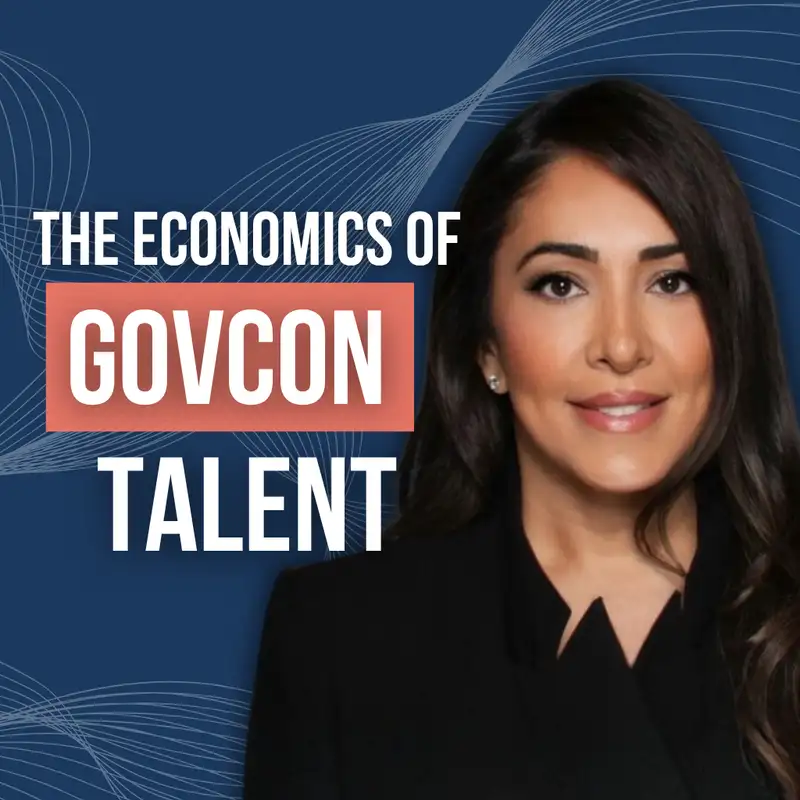
What GovCon Leaders Get Wrong About Talent Strategy | Halai Shukran
speaker-0 (00:00.078)
But in GovCon specifically, the people problem is rarely only a people problem. And I think that exists in other industries, but our revenue is our people in government contracting. They are our product, their skills, their abilities, their capabilities are essentially how we go to market.
speaker-1 (00:18.286)
Today's guest is Halai Shukran, the COO of Pluribus Digital. Halai built the company's people function starting with one hire, and today she is the chief operating officer who runs IT, quality, marketing, and contracting on top of people. She founded the GovCon Talent and Operations Collective, and she leads the Women Executives Group inside the Forbes Human Resources Council, where she's written more than 20 pieces on why people decisions are strategy, not overhead. Here's what you get from this episode.
what it actually takes for a people leader to earn real operating authority and why that's the difference between companies that survive contract-based pressure and the ones that don't. Welcome to People Multiple. My name is Gia Ganesh. Here we unpack how talent decisions act as leading indicators of enterprise value, shaping whether companies tail with strength or stall under pressure. Drop me a line on LinkedIn to tell me what you thought of this episode. So let's dive in.
speaker-1 (01:19.458)
Halai, welcome to the People Multiple Show. I'm so thrilled to have you here.
speaker-0 (01:23.704)
Thank you so much for having me, G. It's been great to meet you.
speaker-1 (01:27.144)
before we jump into your professional journey, I have to start with something you shared. You started in broadcast journalism, not HR. You were a PA at an NBC affiliate and then you were in and out of the White House press briefing room. And I also hear that your name is literally on the wall on the tiles of FDR's old swimming pool. What was that like? Tell us how that happened and then how did how does a journalist end up in HR?
speaker-0 (01:56.162)
Well, I think it's the same way that a lot of HR professionals end up in HR. I don't think it starts with their education or even prior to that as like a a child, right? I honestly have a beautiful kind of experience being a journalist. And I think that is something that I probably shared with you preemptively because I am still super proud of that experience. And it was something that I was super passionate about, candidly speaking.
I think where that landed me is understanding that also with broadcasting comes the ability to adapt to different environments, to small media markets, to move every year or two to essentially make it in some of the larger media markets in some of the bigger cities. And I think that naturally, while I enjoyed it so much, created a stopgap for me. I'm a very family-oriented person. And so I was like, do I really want to move to small towns and
You know, do this for the next 10 to 15 years. You know, a small number of people make it big very soon in their careers as journalists and in the broadcasting space. So I I took a leap of faith and I moved to Southern California. I took a corporate trainer position on the HR team for a small ad agency in Southern California. And honestly, the rest is history. I think that that specific situation afforded me the ability to grow.
in a short amount of time because while I came into a company that really valued HR, it was a company that I was also going through restructure after restructure. So candidly speaking, I was probably the lowest compensated, the easier one to pick to stay. and I just used it as an opportunity to be a sponge and figure out what else I needed to learn about HR to really understand this space.
speaker-1 (03:43.02)
So I'm curious now, that journey from starting as a corporate trainer to where you are today as a HR executive, a COO, et cetera. Can you give us a two minute version of what that journey looked like?
speaker-0 (03:53.326)
Sure. I think what's the the most pivotal for me, and I'm only speaking from my personal experience. So this isn't in any way, shape, or form to talk about HR as a whole and what is the most beneficial to people's career path. But I think what was beneficial to me at that time was that I started on the actual true talent management side of the HR function. So starting in training, learning and development.
Expanding my scope into talent acquisition and then eventually kind of overseeing all of talent management enabled me to really get embedded on the business side, right? In order to, in order to recruit effectively, in order to support people effectively, you really, really truly have to understand the business, its drivers, where you can create impact, and essentially be able to speak the language that the executives need you to speak from an HR standpoint.
I think the operations piece came second, candidly speaking, the compliance, the benefits, the compensation, you know, r things that are relative to probably more of the generalist route. I kind of absorbed once I position myself to be the end to end HR leader. and what I realized at that time is I don't need to know how to do everything perfectly, but I need to understand how these functions come together from a holistic HR standpoint.
And I think that lens is naturally what also carved that CPO head of HR path to the COO path, right? I think starting with the understanding of business strategy and how to support people. Honestly, I think I was a little bit nosy too once I became head of HR and I wanted to know what was happening in different parts of the business. And I became very intuitive.
And curious about what that then means for us in HR. And I probably did too much talking with my teams about sharing what everyone else is doing and other parts of the business, but I wanted them to see the value add in understanding different parts of the business. And that with the seat that I have, regardless of what my title is, you should find value in what I can bring as I interact with other executives and the organizations. And you should be using that as leverage to be more that much more impactful in your role.
speaker-1 (06:10.698)
I want to share that I had a similar journey as well. My basis and foundation is more on the talent management side and the compliance and the operation piece is something I absorb later on. And like you said, Halai, I had the same thing, you know, it's not something I it comes naturally to me, but I built a team that can complement my skill sets and, you know, and f run the function effectively.
speaker-0 (06:33.324)
One hundred percent.
speaker-1 (06:34.978)
I'm curious, what was the moment your CEO's view of you shifted from head of talent to an operator that he could trust with the entire business? And what do you think was the evidence that made that happen?
speaker-0 (06:46.764)
Yeah, I think, you know, I am in a a beautiful company that is a woman owned small business. Our CEO is the owner and the operator. and so she is a phenomenal person to work with. She's given me a lot of opportunities relative to kind of where I've been able to lean in. So I don't think this is necessarily over the last six and a half years, I wanna say now that I've been with this company.
I don't think it was one dramatic moment that made Jess, our CEO, see me differently. I think it was more of an accumulation of evidence, right? So when I joined, what I got excited about was, you know, was I really excited about doing everything and being the only HR person in-house? Probably not. But I was excited about the opportunity to showcase the value of building a people function at this company. And what I learned very quickly.
Because I was very new to government contracting. I've come from the commercial tech side. I've been a part of scaling organizations. but in GovCon specifically, the people problem is rarely only a people problem. Right. And I think that exists in other industries, but our revenue is our people in government contracting, right? Like we don't have that
speaker-1 (08:06.54)
Product or something to sell, right? Yeah.
speaker-0 (08:09.108)
Are our product, their skills, their abilities, their capabilities are essentially how we go to market, right? So when we think about people problems and what I'm able to uncover in having strategic conversations with my CEO, regardless of what my title was at the time, is that I was able to translate staffing problems, delivery problems, financial problems, or client risk problems that then naturally position me across the business.
not just necessarily the person that's here to help us operate at scale from a people lens only. And this is where I want HR leaders to start thinking about this is that you need to stop bringing forward just HR activity, but start to bring forward more of those business choices, right? That, you know, where trade-offs can't exist, right? Like I don't want to talk about what employees need. I want to talk about where creates delivery risk on programs and what the trade-off should be.
To prioritize maximizing revenue, but also ensuring that our culture stays intact. Right. And I think some of that naturally is turned into an ability to absorb company growth. Right. And I think that that's the that's the success metric, right? So when I'm able to translate people's problems in that way and build that accumulation of evidence for our CEO, I think now what she sees on the other end of that is okay.
Great. If we're growing and we're scaling and we get new prime contracts and we're across a number of different contract vehicles that allow us to grow from a revenue and capacity standpoint, I want to showcase that the operations side of it with the people line of it in tow can support that growth.
speaker-1 (09:52.182)
So when you absorb the other functions like IT, quality and marketing and contracting, did you have to build any new fluency because getting it wrong meant real client risk or is that something that came naturally to you because you were already looking at everything from that lens of what is getting in the way of execution and delivery?
speaker-0 (10:11.778)
What I didn't know at the time, right? It's like I'm you're absorbing all these responsibilities. You also have naturally like I am first generation American. I am a woman of color. I am new to this C suite role. you think you have to know it all, right? And I think the job of the COO is not to know everything, but what it's required me to know is like enough that I can connect risks and make decisions seem
Valuable and visible to the business. So what I translated was essentially thinking fluency means you have to have a the skill set of like systems thinking, right? Fluency is not you know everything under the sun, but it really just means that like I need to think about people, IT, marketing and communications relative to systems thinking, right? So when when I think about what was impactful for me from a people leadership standpoint, is like
A lot of times in HR, people think it's about empathy or good communication. It's really the flow of how decisions move through an organization, where that accountability sits, where you're creating those swim lanes across the organization, the inherent or unintended outcomes of what behaviors are then driven with processes that you create and how change actually lands with people. When you think about all of those things holistically.
That is systems thinking, but that systems thinking directly, tactically becomes part of IT and how we support people from an employee experience perspective, quality, marketing, what is our brand and market? What are we saying is our competitive advantage? How does that shape our culture? And then contractually, kind of what are the limitations and the opportunities with each new program that we bring on? So
I think there's a lot of that relative to systems thinking. And then I think the other piece of it that is directly translatable is the stakeholder management piece, right? HR leaders spend so much of their time like Yes. When when I think about your career, right, you know this probably firsthand and so many people are gonna feel this pain point. We're dealing with competing needs. We're dealing with, you know, incomplete information.
speaker-0 (12:32.878)
Confidentiality issues, yes, risks, strong opinions about things that you think are very much from an HR lens, but everyone has an opinion about it. Absolutely. Yes. we can talk about that all day.
speaker-1 (12:46.88)
Everybody wants to tell you how to do your job.
speaker-0 (12:49.358)
Correct, correct. And everyone knows HR better than we do. I think what that just is similar to is that we have to operate across an executive team and all those perspectives have to come into play. So stakeholder management is a key thing. And I think where I needed to build that fluency to be able to use systems thinking and stakeholder management more effectively was I needed to understand a little bit more about specifics and government contracting, right? Like
contract economics, delivery risk, what does that mean relative to people decisions? Where can a very well-intended people decision damage margin? And where does that create missed opportunities? Right. So I think those are some of the things that I think I use to my advantage, but I also kind of figured out where the connective tissue needs to exist between HR and all those different functions and ensure that
Decisions are visible across the org.
speaker-1 (13:50.304)
You there was so much gold in what you just shared, Halai. I can't even begin to dissect or pull the threads apart. But one thing that I'll say is that, you know, historically HR has been defined as talent acquisition, talent management, and then talent retention, right? The three pillars necessarily. but what you said, it's all about how do you make those people decisions and how those people decisions translate into business results. And one piece of it being stakeholder management, the other piece of it is understanding the economics of how the business operates, etc.
Why don't we talk about HR from that perspective? Or do you think do you see a shift in the industry from the traditional HR lens of compliance operations and management, et cetera, towards this new way of thinking that it's all about people decisions that can enhance the business or detract the business away from delivery?
speaker-0 (14:37.826)
Yeah, I think we should be thinking that way. I think where we're starting to see this shift. And I'm so happy that I am part of like a very special community of showcasing how CPOs can take that non-traditional path. I think it's becoming more traditional, which is exciting to COOs, is because that's where the the thinking is is kind of broadened a little bit, right? I think right now the way that
You know, traditional HR is operated is exactly what you said. I think when it becomes people operations, it's within the scope of compliance or benefits or compensation that that becomes what you're thinking about. But when you think about the crux of every individual piece of whatever those titles are or what they embody, is systems thinking, is stakeholder management. All of those things are naturally embedded into their job descriptions, right? So I think if we are able to
Do a little bit more thought leadership about how teams can be structured relative to systems thinking and then the different pieces of HR that fall under that, right? Like how do we ensure data integrity? How do we ensure that, you know, people and people data are translating across the organization? How are we building the right process so that it's not breaking with the advent of AI? It's not creating kind of missed opportunities. That's how I like to lead in HR.
is to broaden the scope of what you're thinking about relative to your role in your title and really thinking more broadly about how you impact change in the organization. So, you know, I'm so glad you kind of, you know, decided to kind of thread that that needle there and really say that this is something that HR leaders should be focusing in on more from a thought leadership perspective. And I think, you know, if more people get a seat at the table from like a true operating capacity standpoint.
I think we'll start to kind of shift the the industry and the thinking around that a little bit.
speaker-1 (16:32.546)
Hello, so you know, as a leader, you're having to have translate people decisions into business results and also translate business strategy down to the team so that they can execute and operate effectively. Which is harder to do and what do you think we should all spend more time on?
speaker-0 (16:50.712)
I think when you are new to the C suite, translating upward is harder to learn, right? I think people leaders are trained to describe employee experience, engagement, fairness, and risk. And that becomes that one-dimensional thinking that I was just speaking to relative to thinking about your role as a generalist or thinking about your role as a business partner and then operating effectively under the the kind of lens of that title. All of those things individually matter. But
When I think about an executive team, what they need to understand is what are the issues that contribute to growth or hinder growth? What are the issues that impact our delivery capacity? What are the issues that we should be cognizant of when we're thinking about client continuity and that sustained and recurring revenue perspective? And then downward to margins, right? Like we we want to talk about all the wellness benefits in the world and what would essentially retain employees, but how does that impact?
margins. Our product is our people, right? And so we have to also look at it from a business model perspective and effectively where budget follows impact. I think that's the piece that is harder to learn sometimes is being able to translate that upward. But I do think that the downward translation is equally important. And it gets harder as a company grows. Yes. So maybe the tipping point when you think about w where you should optimize for upwards or downwards, I do think that downwards becomes
More important to learn when you are establishing a time where the company is seeing a lot of significant growth. And at that time, prior to that point, you know, strategy would sit amongst the executive team. There may be one additional layer that would help the strategy or executive team kind of execute. But if you don't think about what effective cascading of strategy looks like and who are the people in seat.
To help you translate that downward, I think that's where a lot the a lot of like disconnection happens. And I think that that's where, you know, initiatives fall flat. That's where I think we don't hit the KPIs and the metrics. That's where operations and operating processes start to break and weaken. and I think what leaders have to be able to do is explain what's changing, why it matters, you know, what trade-off needs to be made, if at all.
speaker-0 (19:15.308)
And what each person should be doing differently. We actually experienced this recently. You know, I think, you know, our company, Pluribus Digital, has had significant growth in the last year. I think by year end, we'll be at a hundred head, a hundred people in terms of FTEs. And I think that's one metric. But we are now across, we have four prime contracts. We have a number of different contract vehicles, and there's a lot of opportunity to continue to grow.
but what we realized is a few years ago, we really spent a lot of time focusing in on that people management, middle management layer. But what started to kind of create an attention point is it's no longer just about people management. It's about taking, you know, a senior leadership group and establishing them as the middle layer between people managers and the executive team. Right. And I think that was our way of saying.
We can't be responsible for all communications. We can't responsible for all areas of accountability. And we can't, as executives, sit in each swim lane and drive accountability downward. And who are we leveling up to ensure that they are very cognizant of, you know, feeding information downward, but also holding us accountable to bringing the kind of in the trenches perspective upward.
speaker-1 (20:37.006)
I understand that you've worked both at venture backed companies and now you are in government contracting. So then I'm curious, what people principles hold true across both the GovCon industry and the venture backed industry? And then what lessons don't transfer from, let's say, VC backed companies to the GovCon world?
speaker-0 (20:54.446)
Clarity is always something that is evident across industries, right? Like that's the one thing that transfers super cleanly. Clarity matters, clarity scales, right? People need to understand always the vision, the principles, what good looks like, who owns what. I think anything relative to that across industries, I think stays consistent from an operating standpoint. I think what doesn't necessarily translate that I was just speaking to in the last question was.
Headcount growth doesn't necessarily showcase like a proof of progress, or it doesn't really show kind of where hiring aggressively ahead of demand equals, you know, better opportunities for the business to support the growth at scale that a GovCon firm would have. You know, when you think about a venture back business, those companies may intentionally build ahead of revenue because capital is funding the bet. Yes. Right. And I think that's a different lens.
Whereas in GovCon, our growth is really constrained by funded work. Right? We talk about pipelining effectively and we talk about you know, building a bench. But I think those things where the limitations come in is government contracting procurement cycles are up to 18 months. so how effectively can you keep a pipeline engaged? How long can you keep people on the bench who are not actively billing against contracts and programs?
Which then translates into kind of instability and an inability to sustain those indirect costs. Right. I think that's the biggest piece that I've realized, you know, where budgets and that sort of thing were used in a venture back business. They're modeled and utilized a little bit differently from a government contracting perspective.
speaker-1 (22:45.358)
So would you say that is what is different about your talent strategy compared to a generic people playbook because of the industry you're in and the way the industry commercializes its operations?
speaker-0 (23:00.214)
Yeah, I think I I think so. When you think about, you know, the generic people playbook, you're thinking about across industry. Yeah. Right? How do you envision HR in any industry? And I think those principles matter. But I think when you are at, you know, a small business, a woman owned small business at that, which then presents great opportunities from a procurement standpoint, but also may limit you in scope. you may be kind of, you know.
working against larger companies that have more opportunity, more budget for some of the things that I just mentioned earlier. But I think when you think about a generic people paybook, that opportunity, it's it assumes that opportunity is essentially limited mainly by demand, right? When you think about our business and the business that I operate currently, that opportunity is shaped by access, access to networks, access to contract vehicles, to partners. Who do you know at what federal agency
And what does that mean in terms of your ability to build a reputation in-house so that when your name is presented as a potential vendor for any work, or specifically is digital services work, that that name and that vendor resonates with the client. They know the work that we do. So I don't think that when you think about a generic people playbook, talent strategy should always exist. I think sometimes when you're operating operating in our industry, you can't just wait for contract awards.
Right. Like you have to think about how talent strategy and people strategy are, you know, exhibited and executed against in an industry that may not afford you the ability to do it as an early investment and take it on as overhead.
speaker-1 (24:41.554)
That's a very fascinating industry. I have never worked in government. So just the hearing you talk about it is very fascinating. So I'm curious then, because you mentioned some of the contracts, it takes about eighteen months for the procurement cycle to come through, which means you have your staff sitting on bench at times. How do you keep those staff members engaged, waiting for the contract to come through? Is one part of the question. And the second part is does that impact the numbers that you and the CEO are focusing on and
Is that something you care about? You know, it obviously impacts the bottom line. So I'm curious, how does retention and employee brand, the brand that you built so consciously and intentionally, show up in numbers that you and the CEO actually care about?
speaker-0 (25:27.64)
I mean, I think retention at any organization is critical, right? but we have to look at it a little bit differently, right? And we think about, you know, ensuring that we're giving opportunities to enhance skills, up skill where necessary, understand different federal agency ecosystems, and really an be enablers to the rest of the business as we are thinking about what is that next opportunity that maybe may come on deck and essentially become
The billable opportunity for those people on the bench, right? So as a small business and government contracting, part of that retention strategy that also then translates into business impact. And that's where we toe the line from a cost standpoint is we probably would love to have some overhead capacity that helps us determine, you know, you know, where we have some skills, where our capabilities and the existing scope of work that we've taken part in.
you know, relative to case studies or past performance, how that be would be beneficial to the business development side. Where can we get some people on the bench to think through our growth strategy? Where can we get people on the bench to support tech challenges, orals presentations that become part of the procurement process and government contracting? And so naturally, if that person was even billing on a program, we would probably put them on overhead anyway to support
the organization and provide capacity in that regard, right? They're the hands-on keyboard doers. And so naturally they are the people that we would get involved. That is one critical way that we retain and offset any budget impacts relative to people being on overhead, because we would do that anyway. But what creates the sticking point is how long people are on that bench. Right. And so we have to be very intentional about overhead support.
what where there are limitations from a revenue and revenue impact standpoint with how long we can sustain people in the bench. But that also then means that we are working in lockstep with our growth and accounts team to really understand where our existing pipeline opportunities sit and in terms of contracts that we're going after and really understanding when they could potentially land because government timelines also slip, right? So if we're expecting something to be awarded
speaker-0 (27:48.724)
In September, for example, of this year before the fiscal year ends, sometimes that could slip into October or November. And we have to plan for some of that slippage. So when we think about retention and employer brand as a whole, it's a little bit of a song and dance and it's more of an art than a science. I wish we can work within the limitations of budget and budget only. But when I talk about overhead investment and what's gonna enable the company to scale.
I think those are things what we need to kind of negotiate as an executive team, right? I'm going to be thinking about overhead investment relative to people, but I'm also going to be thinking about loss relative to skills and seniority and intellectual knowledge if we have to terminate or offboard somebody. but that's where like furloughs come into play. That's where we really think through strategy about traditional offboarding and restructures and furloughs. I think furloughs are very common.
in the government contracting space. I mean, even with what happened last year with a lot of contracts being canceled and that sort of thing, I think a lot of digital services, GovCon folks, kind of flexed into that from a people strategy standpoint. And there were some investments made, you know, benefits and that sort of thing. But I think that then makes your employer brand that much stronger. Right. In an industry where the market is tough, people are here because they want to do mission-driven work. They want to impact
you know, public service missions for good. And they probably want to stay in this industry. So if you are also not just thinking relative to timelines and revenue impact, but talking about growth with these individuals, where we could potenti how long we could potentially keep them in seat, give them timelines and updates way in advance of when contracts are supposed to be ending. So that they can think about themselves and their livelihood the same way we are thinking about that.
Right. And not making any promises. I think that impacts our employer brand from a much more strategic lens. And that's where, you know, even if they are no longer with the organization because it creates some sort of squeeze from a budget and revenue standpoint, they're they're kind of ensuring that our employer brand trickles to other people, right? And they are we have so many alumni that are also have boomeranged back. We have so many people.
speaker-0 (30:12.29)
that continue. I just had somebody that offboarded just a couple of weeks ago that sent us three people to replace their own seat on the program. And I think that becomes part of our employer brand. We're not hiring for programs and contract specifically. We're hiring for our company. And I think that translates in everything that we do.
speaker-1 (30:32.294)
I love that. And I think it goes back to what you said earlier, right? Clarity and transparency wins the game every single time, irrespective of which industry you're in. I wanna shift gears a little bit, right? for a CEO too small to have a people leader yet, what's the first people decision they should make themselves and what does it cost them if they wait too long?
speaker-0 (30:51.65)
I want to make sure that we don't just think about pe like when a company or a CEO doesn't really have the bandwidth to hire a dedicated people leader. Cause I'm now thinking about from a CLL lens, right? I I'd rather not just focus in on people leadership. I want to be way more high level and generic than that. I think what a CEO should be thinking about is really what are the operating items that you are owning that are not enabling you to build and grow the business.
Right. I think that's the biggest piece. What are the things that are keeping you behind a desk versus out in the market, building critical relationships to your growth, giving you that competitive edge, and essentially enabling you to get intel that effectively allows you to hire people like a people leader? Right. I think what are the things that are blockers to your company growth at scale? I definitely think that's where I would start.
And then when you think about people, that naturally shapes people's strategy as an opportunity for that, for that CEO, right? I think when I think about CEOs, where do they establish trust in the organization? And where are they clear with the individuals that they trust? Clarity of expectations, clarity of deliverables, clarity of what enables that CEO to do the work that I just mentioned that will help them grow their company. So
Regardless of you know, whether it's a people leader, if it's an operations leader, if it's another senior leader that is in lockstep with the CEO, I think that's where the CEO should focus, right? Their quote unquote early managers become the company's real operating system long before there's actually an HR function. Because whoever they put in seat that they then trust, those are the people that decide what gets tolerated.
How priorities are communicated, whether feedback happens, what problems exist, and are essentially the ones that are surfacing those problems, that naturally becomes a way to ensure that regardless if you have a formal people leadership function or not, risks and opportunities are making its way upward to the CEO without them having to be responsible for uncovering some of that early on. So they become essentially the ones that are.
speaker-0 (33:17.356)
The operating system, its managers are the people system before you even need to have a people leader. I think managers naturally or people that you trust will naturally ask the CEO, I actually need someone that can focus in on this with me directly. When are you going to hire a people leader?
speaker-1 (33:35.17)
Very true. do you think any of that changes because of AI today?
speaker-0 (33:43.43)
100%. I think if you if you aren't thinking about where some of that changes, then you're probably a little bit behind. I don't think it takes away the human judgment aspect. I don't, you know, from a data standpoint, I think where we can leverage AI is that it's going to naturally uncover risks and opportunities, right? When you think about, you know, KPIs, metrics, dashboards, that's where.
AI would really be able to kind of up-level those people that are systems thinkers, those people that are really thinking about operating systems at scale. But I think what doesn't get taken out is the human judgment piece, right? Like connecting the dots across business functions, connecting the dots across opportunities and market. I think there's a natural ability to research from an AI standpoint where the industry is and where it could potentially go, but you really have to think about where.
your company currently exists, what are the size and scope of your existing organization? Risks and opportunities generally relative to industry shifts are just that. It's very generic. It's very broad. But I think you leverage AI to help you make decisions more quickly, to uncover those risks and opportunities a little bit more quickly, but it doesn't take away the people in seat that help to translate some of that knowledge relative to the business currently, what are its opportunities?
And where it needs to think about w how we operate, what our capabilities are, and to support delivery at scale.
speaker-1 (35:13.17)
absolutely. do you think some of the aspects of people judgment are being outsourced to AI today? And if so, how can CEO stop themselves from thinking that AI can become that people leader per se?
speaker-0 (35:28.286)
how can we just put out a piece and just make sure it stops like the same way the, you know, different presidents and their and within their administration they can put out executive orders. Can we do that from like an HR standpoint just to stop that? but I think it's I think there's a couple of things. I think using AI to uncover risks and opportunities and presenting that and showcasing what the data output is, but also.
Showcasing your additional judgment. I I honestly think you should be able to say, this is AI output, this is human output. And I think some CEOs need to understand the difference and need to be very in a very linear black and white fashion, be shown those differences. And it doesn't become a defensive strategy. It becomes an offensive strategy, right? You think about it and you say, I truly believe.
that this is where humans can create additional value beyond what AI can give us. This is where we can take existing roles in the organization and converge them into being actual people strategists, not people coordinators. Because people coordinators are doing some of the systems thinking that is underlined by AI. And so I think what a CEO may not see is people strategy, right?
And again, this goes back to some of the conversations we had earlier in this call, Gia, is what is happening today is we are thinking very linearly relative to roles within HR. But all of that is going to change. And that's where the thought leadership comes in. That's where when you're thinking about systems thinking, that's where when you're thinking about data, and that's where you're thinking about being a people strategist, this is our really our opportunity to talk about what people strategy actually is. Use numbers to back it up. But I think what we've
Overindexed on is coming in with data and using humans to drive some of that data. But I think showcasing where humans are adding value on top of AR and being explicit and showcasing that I think becomes a little bit of an advantage to kind of ensure that we're not thinking it's either AI or it's not. It's HR leaders or we essentially outsource people leaders to AI, right? It's not that black and white yet. I don't think we're even close to it being that black.
speaker-1 (37:56.788)
Absolutely. switching back to GovCon for a second here, I believe you're part of a collective in the GovCon space. Can you tell us a little bit more about that?
speaker-0 (38:09.324)
Yeah. I I think it almost just started from like a capacity standpoint for myself. I think I was new to government contracting in 2020, at a time when HR was managing so much change already with a pandemic in tow, everyone remote, and really HR forcibly getting a seat at the table to think up strategically about how do we solve for all of this. I had to also think about that in an industry where.
Everyone was on site alongside their federal clients. They were working within the federal agencies, not necessarily a home office that is conducive to the the corporate kind of office. I think it's it's what I realized is I needed capacity. I need to learn quickly. And what I also realized is some of these other smalls are also have other people in seat that are operating as a one man show, right? I I'm not here to say that HR.
is very mundane and tactical, but there are aspects of it that are mundane and tactical. And as you're building a people function from the ground up, which a lot, a lot of other smalls in our industry were doing, it became interesting because, hey, let's let's be real. Not a lot of what we're doing is groundbaking here. But what I was able to think through was our competition in GovCon also become your partners?
And i if you don't work within this industry, that becomes a hard concept to grasp. Because even though, you know, myself and our company are going after the same opportunities that our competitors are going after, if a competitor wins it and we have an opportunity to support them and bring on a team with a specific set of niche skills that will enable that business to be successful on that program.
then we would essentially go to them with our people and present ourselves as effective subs, right? Subcontractors. So we would essentially become partners in that regard. It behooves the HR and operations folks at these smalls to start to work together, to build a talent strategy amongst, you know, digital services GovCon firms. And that was the the value that I saw in building this collective. I may have people rolling off of a program because that program is ending.
speaker-0 (40:31.96)
Those people may have future homes at some of our partner companies, some of our competitors in this space. One, from an employer brand and from a human standpoint, you're creating an opportunity of continuity of income and livelihood for individuals that have shaped your business in a very strong and successful way and now have an opportunity to take those skills and go elsewhere in the same industry. We it we want to keep people in our industry that wanna do good.
public service mission driven work, right? So when I built this collective, it was my way of like sounding the alarm, but also bringing people up together and building a community of people that are wearing multiple hats. Some of the people in this collective, there's like, I think at one point we were had 40 to 50 individuals. It became just a slack community and then it became an opportunity to meet monthly. And then it became tw twice a month and then
You know, we kind of flexed it based on what activity was happening in different Slack threads and that sort of thing and where the need was. But what it what what it was was HR folks within HR, people that are doing recruiting and maybe recruiting only. It became people that are also wearing the operations hats. It became people that are also supporting, you know, proposals and doing business development work and just sharing strategies, sharing people, sharing resumes, what's worked. I think another thing that it also kind of made me realize is
Where HR Tech seems like a very kind of saturated market over the last few years and there's been a lot of consolidation of HR Tech. Not a lot of these firms in government contracting are using some of the most innovative new solutions relative to HR tech. And where are there limitations in existing HR tech that are not compliant with certain government contracting standards? So
These are conversations that all came about from the collective and meeting with these individuals. You know, it became a sharing of knowledge. It became an opportunity to learn. I was able to learn so much more. I said it, I did it selfishly in the beginning, but I was able to learn so much more. But I was also able to kind of share the wealth on some of the work that I've done in my business that may be inf impactful to them and give them a stra some.
speaker-0 (42:53.76)
inside look into people strategy and give them a seat at the table. especially for others that were new in GovCon. So that was really my impetus and bringing this great group of people in together. We still kind of have our Slack thread alive and well. We share industry events, what we should be thinking about relative to industry changes. And I think it just it's an opportunity to take some of the theoretical elements of people strategy and make it a practical place where we're actually supporting each other from a delivery standpoint.
speaker-1 (43:23.598)
I love that you built that community for a niche set of people in the government space, right? It's not something that you know, being part of other HR communities may not give people the same value as the niche community that you've built because of the intricacies of the government world itself. Halaya, moving us to the last part of our section, which is the rapid fire section. What did you build in your first six months that still shapes Plurribus Digital today?
speaker-0 (43:48.62)
I think that the biggest thing that I thought about was capacity relative to people in general. I think when I came in, I was a flavor of all the things. You can think about building a people function from the ground up in a business that its product is its people, being able to staff effectively and quick enough essentially becomes the revenue driver. So what I started to
Talk about a lot more quickly than I probably would have at any other organization is why recruiting matters and why to create additional functions that are just recruiting and recruiting focus so that we can onboard people effectively, support any SLAs from a program delivery standpoint, and make sure that we are effective.
In that regard, so that we can build an effective past performance at these contracts. Right. When you think about coming in at a smaller business, you're just trying to build a reputation. And that's not just reputation relative to people strategy, but it's as the company as a whole. And the people that we have in seat effectively delivering on these contracts becomes the most important when you're trying to build a people function from the stand up, from the ground up. I think when I came in, I was the overarching director of HR and
Take our processes and help us think from an HR lens. And honestly, it became we need a recruiter and see. We need to focus just on recruiting. And that's the biggest value add right now.
speaker-1 (45:23.82)
Yeah, exactly. Because of what you said, you know, be people are your products and you need to continually invest in bringing the right people into the team. What line item looks like an HR cost, but it's really revenue protection? Is it just people again, adding more people?
speaker-0 (45:40.05)
It's recruiting capacity. And this is probably where I was a little bit immature in my leadership, candidly speaking, right? I think as HR leaders, one, you know you're a cost center, first and foremost, and that creates a little bit of inherent trauma. especially if you've experienced what it means to be a cost center what relative to kind of some trying times at organizations. Mm-hmm. And when you think about recruiting and recruiting capacity, it o it's always the first to be hired back and it's always the first to go.
When you think about some of those difficult times from a business standpoint.
speaker-1 (46:12.076)
Yes, I've been through the exact same situation. I know what you're saying. Yeah.
speaker-0 (46:15.726)
my gosh, I've been through it so much, especially on the commercial tech side, right? I what is great about government contracting is like, you know, you you essentially have a planned opportunity for programs supporting you for, you know, regardless of how long the perform periods of performance are. Is it three years? Is it five years? And that creates a little bit of stability in terms of a financial planning perspective. But I think what I want to continue to double down on in the especially with the question that I answered previously is that.
It's recruiting capacity. Like we can't lose sight of the need to keep some of that in house, to think about recruiting capacity at scale. Where do we need to establish search support? Where do we need to kind of work with either fractional recruiters? When where do we need to work with you know, offshore support or create automation in recruiting to support recruiting capacity? I think although in GovCon it can be look at
as like something that can sit in the backlog and because we're waiting for revenue to come in. But that just means that from a financial planning standpoint, you're delaying revenue once awards are given to the company. And we need to think about that relative to livery strain and client risk.
speaker-1 (47:28.94)
What PN P L question should every people leader be able to answer without preparation?
speaker-0 (47:35.596)
I think I'm gonna kind of make sure that we're thinking about this in the GovCon lands because I mentioned budgets are different, right? At venture back companies and in government contracting. How does our labor cost, bill rates for specific people on program, utilization relative to how long they're bill billable and vacancy assumptions affect gross margin? Where does it impact how we make people decisions and how is that moving the needle in the right direction? I think.
If you understand all of the specific elements of consulting and how that j impacts people, I think that's the biggest thing that we should know from a profit and loss standpoint.
speaker-1 (48:17.282)
And our last question for the day, our signature question. Halai. What's a talent decision that changed a business outcome that no one in the room recognized as a talent decision when it was being made? But it was you know, proved to be really impactful to the business.
speaker-0 (48:33.07)
I had to really think about this one. Cause you know, it naturally when you are coming from the HR and people lens and talent lens, you're gonna automatically think of it as a talent decision. Yes. And I have to really think back to say, what were some questions that I asked that is very inherent to my nature and how I work and understanding business scope and strategy that then naturally gave me the ability to build the pe people of function more effectively.
I'll give you a very concrete example. When I started, it was in 2020. I think at the end of 2021, when we felt comfortable, probably a little bit more so to be in person, the majority of our leadership team was still in the DC, Maryland, Virginia area. And we essentially did our first retreat, right? And it was like our
Opportunity at that time to really say, okay, we're no longer in React mode. In 2020, we weren't only dealing with everything that everyone else was dealing with, but it was our first prime contract in a long time. we had won right before everyone re remote. It was awarded in January 2020. and we also onboarded our new CEO and myself at that time. Okay. So this retreat became our opportunity to not only just
Essentially build relationships in person. I think we had gotten super close behind the camera. but it naturally started to uncover some of the things that we weren't thinking about because we were just in React mode. And the other thing that I didn't even mention, we also went through a big rebrand in 2020. So there was a lot happening. I won't even go into the specifics of that, but it was very exciting time. And when we went into that retreat, I was still understanding government contracting. I myself was no longer in React mode.
And I was really thinking about, you know, in government contracting, we've had some great wins. And now we have this new prime contract. But everywhere else in the business, we were just subcontracting to other prime vendors. The question that I asked just very candidly at that time was like, what does it mean to be a strong subcontractor? And what does it mean to be an effective prime? And do we know?
speaker-0 (50:54.762)
Relative to where we've been able to create an impact and where we've been able to grow our business, what avenue do we want to take? Do we want to continue to be that strong sub or do we want to continue to grow in the prime landscape? Right. And think about us as a effective, strong prime across portfolios, across contracts. And what does that mean in terms of where we're making investments and growth? How we go to market?
Our capabilities and how we continue to grow and expand and articulate our capabilities. And then thinking about how we do we align some of those growth strategies to how that then becomes operationalized through people. I was honestly thinking about if I'm an effective sub, I just need to find really strong doers, right? I need to find people that have really strong engineering skills at all levels. I need to think about that with.
Designers. I need to think about that with product managers because we that's kind of our capabilities in-house, right? And then if you were thinking about being an effective prime contractor, that comes with additional overhead investment in terms of who's managing your portfolios. Where do we create investments on the BD side to ensure that we are our go-to-market strategy is effective and we are thinking about capture management? I think that's where I was thinking about people.
But it was really relative to business strategy. And I don't think I even knew that's what I was doing at the time. I just wanted to learn more about what is our opportunity as a business and how does that essentially create visibility for us in this industry. And it I think it naturally helped me start to think like a COO without even realizing it at the time. It was really about how people, systems delivery, and economics connect, but starting more so from the economic standpoint and how we're positioning ourselves in market.
speaker-1 (52:47.734)
I guess being curious and like you said, nosy has helped you get to understand the business and where the CO at more effectively.
speaker-0 (52:57.312)
Yeah, I tell everybody in the organization, they probably are so annoyed with me because I say it so much and I've said it ac I've said it across organizations as I really truly believe curiosity is a is the most undervalued competency for anyone in an organization, specifically leaders, right? And I think naturally the more you become senior.
It it probably prohibits you from tapping into that because there's this fear of not knowing. There's this fear of what it that tells the people that are working underneath you and report to you, or maybe what it tells the senior leadership team or the executive team or the peers that you work alongside. But I think that humility goes such a long way in establishing credibility because when you're asking questions, you're just gaining you're hopefully working with people that want to give you an answer.
To help you gain that knowledge and I think no matter what, that's gonna help you grow in your career regardless of what role you're in.
speaker-1 (53:56.302)
Halloi, this has been extremely valuable. This is a lot of gold that you've dropped in our conversation today. Thank you so much for joining me and appreciate everything that you've shared today.
speaker-0 (54:09.026)
Thank you so much, Sia, it's been a pleasure.
speaker-1 (54:12.344)
Thanks for listening to People Multiple. If you found today's conversation valuable, don't forget to give us a five-star review and share it with a colleague or fellow investor. And don't forget to follow the show on Apple, Spotify, or wherever you get your podcasts. Follow us on social media using the information on the screen and in the show notes below. This has been a production of the AGN Group. I am Gia Ganesh and I'll see you next week as we continue to explore how talent shapes multiples.