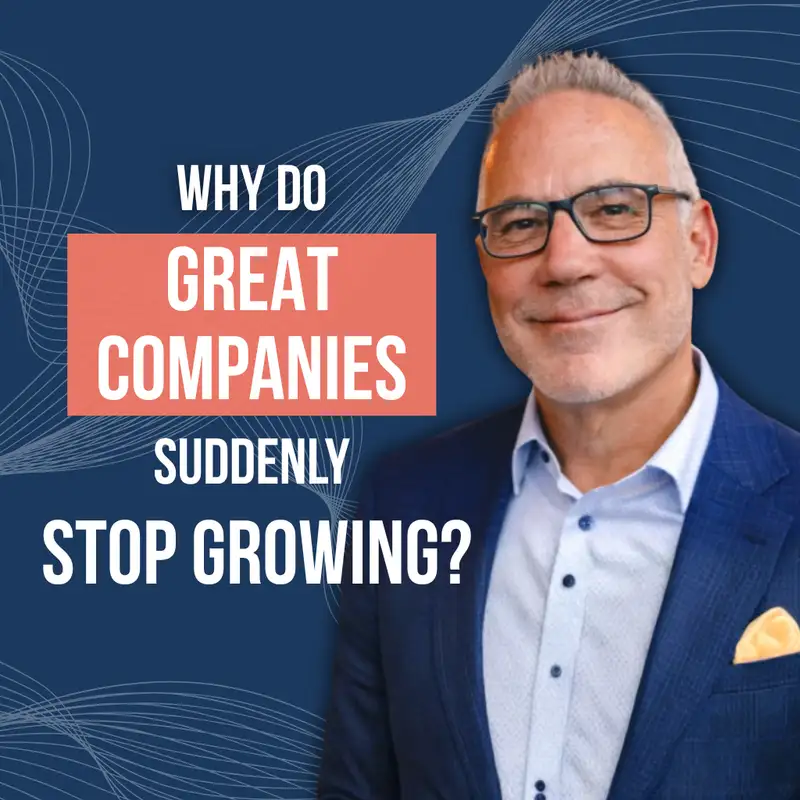
Why Great Founders Struggle to Become Great CEOs | Steve Schloss
speaker-0 (00:00.322)
The level and quality of an HR organization in these companies is often a reflection of the founder CEO's view on the function itself and whether they see it as something that's creating real enterprise value or it's just a necessary thing to have.
speaker-1 (00:16.558)
I'm thrilled to welcome Steve Schloss today. He has spent four decades seeing people decisions from both sides, inside-scaling public companies, building the people function, then across a PE company watching the same patterns compound. He is a two times former Chief People Officer and operating partner at Edison Partners. Today you'll hear how to see your people decisions the way an investor eventually will and why that view arrives earlier than you'd expect.
Welcome to People Multiple. My name is Jia Ganesh. Here we unpack how talent decisions act as leading indicators of enterprise value, shaping whether companies scale with strength or stall under pressure. Let's dive in.
speaker-1 (01:03.33)
Hi Steve, welcome to the People Multiple Show.
speaker-0 (01:07.047)
Hi Gia. Pleasure to be here and happy to have a great conversation.
speaker-1 (01:12.024)
Thank you. I'm looking forward to it. Steve, I want to start us off with something that I learned about you. I understand that you believe in the power of small rituals. Is there one or two that has helped you in your life that you want to share us share with us today?
speaker-0 (01:27.755)
I I I grew up in a very, very organized, almost O C D like family. My parents were German. And so I have this ritual where when I end my work day, I want to make sure that my in this case my home office is clean and simplified. And so I've been doing this for no matter where I work for 40 years, it just makes me feel good. So when I come in the next morning,
I feel like I'm dealing with a sense of calm and peace no matter how busy the day is. And so this orderliness is important to me. But at the same time, I also like to have music playing in the background. And music has always been a part of my life from childhood. And so when I am working, whether it's with headphones on or just in the background, there is always a low level of some kind of music playing. It just it just gives me a sense of.
of calm in low or high productive moments. So those are two rituals that are valuable and important to me. They're just kind of part of who I am.
speaker-1 (02:36.664)
Love that. I wish you could teach my kids to clean up their rooms every evening after they're done for the day.
speaker-0 (02:44.276)
Listen, I couldn't teach my own kids to do it, so I'm not even gonna try to teach yours, so it's all good.
speaker-1 (02:49.998)
So let's talk about your amazing professional journey, Steve. You know? You've you've had an illustrious career in the past, I wanna say three to four decades now. And I want to start us off during the earlier part of your career when you were in traditional HR, right? Mm-hmm. And you've you've come up come with the philosophy that even during your corporate career as a traditional HR operator,
You were less focused on traditional HR and more focused on organizational performance in terms of business outcomes. What was it that made you see things differently and what is it that you saw differently at that point in time?
speaker-0 (03:26.816)
So I can't say this was by design, but it certainly started that way. My career started in recruitment. And so because I started in recruitment, I became very conscious of very early on the impact that a hire makes on a given team, a function, or a company. And the more hiring I was doing, the more consciously aware I was.
By virtue of staying connected with them, the impact that they were having on whatever business that they were part of. And it became very present to me that in the world of HR, people tended to view recruitment as an after part of the function as opposed to a core part of the function. And I, in many ways, felt unique.
As most HR folks at the time were more employee relations focused versus talent acquisition focused. And so I became more part of what I saw as having an impact on the business. The second thing is I had leaders who were real great mentors who understood HR through a consultative lens. And they taught me early on the impact through.
measurement and seeing performance result in some kind of financial implication, process implication, customer implication. And it in some ways translated to the experience I had back in the early to mid nineties when I attended the Dave Ulrich University of Michigan HR executive program and understanding that
further through kind of looking at the world outside in. So ultimately, when I was in more of the leadership position of building companies, building functions, leading organizations through change, I had this grounding that helped make a difference in the way that I was working with those that I was serving or working with in leading efforts to affect something that was measurable and hopefully sustainable over time.
speaker-0 (05:50.606)
So that's kind of a picture to answer your question.
speaker-1 (05:54.392)
So it's so interesting that even in the nineteen nineties, it sounds like there was this focus on HR adding value at the business level, not just at an operational level. And here we are, several decades later, there's still a question mark in terms of is HR adding value at the business outcome level, right? I find that fascinating that this conversation has gone on for several decades now.
speaker-0 (06:18.41)
Yeah, sadly. And so when I was recruited in to work at Citibank, this is now in the late 80s, I joined this organization called, at the time it was called City Search. And ultimately it was a team that I took over and led, which was an internal mobility organization reporting up to the chief technology officer. And our role was
speaker-1 (06:20.982)
Sadly, yes.
speaker-0 (06:46.836)
leading the global internal recruitment and movement of talent across the tech and operations world. And so here you were directly identifying talent and moving people inside the organization. So I was not the the notion of thinking about how to make an impact here we are in 2026 with that question, knowing that this is exclusively what we were focused on in nineteen
eighty seven through ninety. it's it's disappointing to hear, but it's also a recognition that the function just continues to have to find ways to create value as the world is changing around it. So I think that's probably the main reason why this is a constant conversation.
speaker-1 (07:36.214)
I I think definitely things have improved quite a bit, but it's not completely w I don't think we have the same level of respect as some of the other functions do by default. I think we'll get there sooner, hopefully.
speaker-0 (07:49.686)
Exactly. Exactly.
speaker-1 (07:51.762)
Steve, you shifted into the world of PE at some point earlier in this in this past decade. And I'm curious about what happens there in terms of like PEs and VC firms increasingly have begun to start talking about talent as a value creation lever, and you've had this opportunity to watch that evolution up close. So what's changed in your observation in the last decade from that perspective?
speaker-0 (08:19.096)
So, I mean, to to be clear, my experience in private equity is about six years when I started my practice, and I'll make the connection in a second. But I would say the the experience that I had going into sports around 2013, 2014, before my move into executive coaching into private equity, is a similar journey, which is like private equity, like sports, these are two industries.
That many people aspire to be part of for very different reasons, but have a certain language, a certain brand, a certain approach, a certain excitement attached to them for different reasons. And yet, when you begin to get into them and you see that world from the inside out, you also begin to see a real lack of sophistication or a state of
forward thinkingness that you would have thought is embedded when in fact the opposite is the case. So in the case of private equity, you know, private equity had always been a financial engineering effort. And it's very much about meeting the financial thesis and having the investor and the board work with the CEO and the executive team and ultimately driving to a successful exit, let's call it,
20 quarters down the road. So you essentially have 20 quarters worth of opportunity to create some kind of sale, IPO, secondary investment, next level investment leading to something greater over time. So there's always a time frame here. And what I've have found is as whole times have extended, it also became clear that the question of talent
As a lever for value creation has become more important. That doesn't mean that private equity firms are well prepared to address the question of talent. They certainly were well prepared around executive search, but not around the topic of what do you do with the existing talent? How do you drive CEO performance? How do you improve leadership team performance?
speaker-0 (10:41.186)
How do you address the individual coaching needs of a given chief ex-officer, whoever that might be? And what I've seen is I've seen some firms move positively in that direction. I have seen firms build their own reputation in servicing private equity portfolios by offering data-driven approaches and instruments.
That allow them to aggregate the data across multiple portfolios of companies. So I think you're seeing a greater effort in this area, but it still has a long way to go and compared to larger fortune organizations or even mid-size organizations who are not necessarily private equity owned. And the good news is it's moving in the right direction. But the one gap here, which is partly what I do, is what is the extent of
coaching and sustained coaching that private equity firms offer to their portfolios.
speaker-1 (11:42.83)
That leads me very well into my next question, Steve, which is most operating partners at private equities are focused on, you know, product, go to market, finance, or operations. I am so fascinated to learn that Edison decided to bring you on as a leadership effectiveness coach or expert, and they decided that this role deserved its own operating partner premise. Tell us a little bit more about how that happened.
speaker-0 (12:10.232)
So it just so happens that I was a chief people officer of a tech company back around 2010. And it just so happens my colleague was a chief marketing officer who left to go work into ultimately a private equity owned company and ended up joining the firm that was a major investor called Edison Partners, which is a lower mid market firm that was based in Princeton, but now based in Nashville.
And Edison became an early client of mine when I started my practice six years ago. And I worked with Edison's partnership as a team coaching engagement. It was at the end of that experience going into early 2021 where they came to me and said, you know, we like what you did with us. Is this something we could do in creating more value inside our portfolio? And there's something called the Edison Edge.
Which is the value creation arm that Edison uses to differentiate itself across many functional domains? And would you be willing to do this with CEOs and C-level executives and executive teams? And the answer was absolutely yes. What a great platform to help these growth stage organizations. And so that began the journey. And I'll admit to you that the start was a little.
not rough, but it was lacking in real structure and impact because not only was it new for the firm, it was also new for the portfolio companies as to how do I work with a person like Steve in helping me be more effective? What should I expect of him? What's the level of confidentiality I could have with him? Because he's both a partner and an investor of the firm.
But he's also operating as an executive coach where ethically our conversations should be in fact confidential. And every single one of our conversations conversations are absolutely confidential, but it was a new process for everybody. And over time, what we've learned is whether it's in the diligence phase pre investment, is the importance.
speaker-0 (14:28.408)
Importance of setting a tone of trust and a regular cadence of engagement, especially in the first 180 days, where the focus on being authentically people-centric, on helping a CEO and a team understand that the level of urgency changes on the other side of investment means.
You have someone in me to help you navigate that both personally and professionally, because there is a difference. And how can I help you navigate this new stage that you're embarking on, ultimately leading to some kind of exit down the road? So that's that's kind of how Edison has approached it, and to their credit, have been very, very supportive and I think.
forward thinking around how we can do this not just at a portfolio level, but also as we collectively support CEOs in cohorts for peer coaching to running annual CEO summits for their benefit and their learning.
speaker-1 (15:39.118)
have you seen other PEs offer a similar service at all, or is this unique to Edison? Because I haven't seen this openly offered at other PE firms, Steve.
speaker-0 (15:50.438)
So if I use LinkedIn as one measure of it, I think every PE firm in some way might have an annual summit of some type. and that's that I think is pretty standard issue. However, the extent to which they offer discrete, focused support for CEOs and portfolios.
with someone who is dedicated to doing so versus just transactional transactionally saying, Hey, go work with someone, go find them, or here's a couple of resources, you figure it out. I suspect that's more the extreme than the rule.
speaker-1 (16:32.765)
that's great. Then Edison has figured out this way of offering premium level service to its portfolio CEOs.
speaker-0 (16:39.712)
AKA value creation, as it's
speaker-1 (16:41.858)
Recreation. Yes. So Steve, you know, in coaching all these CEOs and other leaders at portfolio companies, I'm curious about what business problems that show up as revenue or execution or growth issues are actually leadership problems underneath.
speaker-0 (16:58.658)
Yeah, look, I I would say that business problems generally in the lower mid market range are always gonna start with product market fit, scalability, the ultimate question of are they moving fast enough and smart enough from a a process product and tech point of view. Okay, so I'd say that that that is fairly universal.
But the lever ultimately becomes what is the quality of leadership around the table? And what are they doing themselves that help or hinders the performance that they're being invested in in the first place, which is really where I come in. And ideally, these are things that are getting culled out through the diligence process, the assessment of that. But for the most part, given the size of these companies.
I would say that a bad product, bad tech, not enough new logo growth are going to be issues for which, yes, you could probably translate some reason to being a talent issue, but oftentimes they don't define it as a talent issue until it's too late.
speaker-1 (18:18.968)
Hm. So you just referenced the diligence process and I understand that you are involved in the diligence process. So t walk me through what that leader founder assessment looks like before a deal closes and what are you trying to find out at that stage?
speaker-0 (18:34.904)
So, you know, this process has definitely evolved over the many, many diligence conversations I've had over these six years. And so the the net objective here is to understand the scalable skill behavior and coachability of those who are stewarding the investment of the given firm that in this case Edison is making in them.
And my job is to focus on personal and team leadership skills and behaviors that through structured interviewing, I can begin to get a holistic picture of not just the founder CEO often, but the members around the table and to with it potentially do an assessment, not always, but potentially do a structured assessment.
To provide a window into where there are risks, where there are strengths, where there is near-term strength, but maybe long-term gap. It might also involve a, let's call it a pre-coaching data gathering understanding, such that this conversation is also helping me.
Understand how I can best help you on the other side of the investment as well. Especially if there's a higher than likely result that the investment is going to be made. That's not always the case. And sometimes it may come as a result of what I'm observing and gathering and hearing. but normally speaking, it's very much of a precursor to a sustained relationship over time.
speaker-1 (20:22.446)
So in that case, have you looked at a leadership team and found that the business was really good, but the team didn't look like they would get Edison or the firm to where it needs to go and has that been factored into whether to invest in that organization or not?
speaker-0 (20:38.432)
yeah, absolutely. I I'm thinking of a recent potential investment that had an outwardly strong founder who I met a couple of times, and we had two very intense in-depth interview conversations. And then I had follow ups conversations with keen team members, and the disconnect between what I was hearing from the CEO versus the team was pretty stark.
And you marry that up against some of the disconnect that you were seeing in the other functional areas, primarily around product and go to market. And it raised enough red flags to raise the question: is this an investment we should be making right now? Or is this an investment we should be making at all? Because sometimes the result is an absolute no, or the result is.
Let's wait another year. You've got other things to work on before we're willing to put the check into play. And that happens from time to time because at this stage, and this is often an issue, is some CEOs go into performance mode as opposed to authentic mode. And part of my job is to separate that because
My job is to help you understand yourself and the team to do the same. And so that means the baseline by which our conversations start from is not you performing for me to get the check written. It's that I need to understand the truth below your performance. And that's where some of these things tend to uncover.
speaker-1 (22:23.576)
Can you give us an example of a type of question or category of question that you would ask to uncover somebody's true authentic self versus the performative self they put in front of you?
speaker-0 (22:33.912)
Well, one of the critical things that I focus on is what I'll call very generically is coachability. And that is what have you experienced in the past that you have learned from or that you've received very, very specific feedback on, how you respond to that feedback generally from the board or from your team, and what's different about how you're operating going forward? And do you see this as something that's valuable? And
How do you translate that into the practices and how you lead? Some people might respond very superficially. Some people might respond very self-aware, but also self-owned, such that they can walk you through how they were feeling at the time, the action they took, the learning they had, and the recognition of the fact that maybe I don't know everything I think I know.
And and that's that's a gap for me that I want to continue to focus on going forward. And a number of times I'll hear a CEO say to me, I may not be the right person to run this business on the other side of the investment, maybe two years from now. Maybe I'm not the right person and I need to be open to that as part of this process. It doesn't happen often, but when it does happen, I note that because they might in fact recognize that.
Taking the exit at that moment might be a better choice for the success of the business or soon thereafter, as opposed to sticking around and hoping it works. it doesn't happen a lot, but when it does happen, I give credit to the founder CEO who acknowledged maybe there is a limitation to my growth, at least enough for me to put it out there as an open question.
speaker-1 (24:22.51)
And that level of self-a-awareness doesn't come with everybody. So I love that some people are able to share that in the interview process with you. And I think you coined that phrase behavioral malleability. I think it was the other phrase you used in one of your LinkedIn posts to refer to this coachability aspect. And I thought that was great, you know, just being able to a s suss out how malleable these people are when it when they receive feedback.
speaker-0 (24:30.604)
Absolutely.
speaker-1 (24:47.098)
I use a similar question when I interview people as well. Of course, not for the purposes that you do, but when we bring people on board, especially at the senior level, that is a question I ask as well, Steve, which is what is some feedback that you've received that was difficult to hear at the time that it was given to you, but ultimately has proven to be valuable in your professional growth? A very similar vein, and it gives me a very interesting set of answers that again helps me uncover if this is a superficial answer or there is a true authentic.
self care that is being disclosed.
speaker-0 (25:18.924)
Yeah, and I think it's important to recognize that we all understand that founder CEOs are different in what's required of them at, you know, five or ten million ARR versus at a hundred million ARR. Mm-hmm. And one of the things that I have to deal with in working with these founders is helping them navigate their own transition through this process. And
What I find is there are just some things that tend to be markers that help me help them, but also maybe even understand something about them even as early as the diligence phase. You know, how self honest are they, what their approach is to hiring talent at scale, and how they tend to be intentional in those approaches. how effective are they at letting go over time?
How do they navigate the demands of the new board structure on the other side of the latest investment round? As as one of the CEOs that I work with calls it, how can you help me fire the hustler and hire the CEO that I need to be without losing an identity about the hustler? And how do I navigate that transition, for example?
speaker-1 (26:42.158)
Is the that example, the hustler example, is that a behavior that could be viewed as a liability when a company goes from let's say ten million ARR to like hundred million ARR? Does some of these behaviors that are necessary to be to take the company off the ground, do they become liabilities later on?
speaker-0 (27:01.154)
I mean, I think naturally speaking, an entrepreneur is an entrepreneur. And so, you know, I'm sure you've seen the the f the the famous memo that went around last year around founder mode versus manager mode. Yes. Yes. And and that was a big conversation. And to me, it's a question of context, but it's also a question of who is the person
I facilitate a cohort of CEOs through a quarterly peer coaching exercise. And we had a conversation around this exact topic. And one of the questions was: how do I identify myself as a CEO today? And I I am a I am a hustler. I started something and I'm trying to build it further. And I need to know when to turn that on and when to turn that off, or when to use it.
situationally in a way that's going to get the outcome that I need. But as I grow the number of people in the company, as we grow the business, in some ways it might be less useful than it might have been in the past, which means I have to learn the art of diplomacy, which may have been less of a concern when I was busy declaring things because everything was kind of the energy was driving through me as opposed to me enabling a group of people who are now part of a team that I built.
speaker-1 (28:24.758)
Yes, that's the hardest one for CEO founders. I want to switch gears. At one point you I think I read somewhere that you described yourself as an anti playbook kind of person. Tell me a little bit more about why and what that meant.
speaker-0 (28:28.632)
For sure.
speaker-0 (28:39.778)
Ha.
speaker-0 (28:44.514)
You know, when I started in Mike's my PE experience and I met other talent partners or people that were parts of value creation teams, one of the things that really struck me was how playbooks are very much part of the equation in post-investment activity between portfolio company and investing. And
There's nothing wrong with playbooks, especially we have large, complex organizations where you're trying to create some consistency in the way that you're managing the portfolio of companies that you're investing in. But that doesn't work when you're dealing with small to mid market private equity, especially growth stage investment, because things need to be a little more bespoke. A playbook could be more useful through the lens of pattern recognition.
And situational relevance that you've seen this enough times to offer insights, frameworks that I believe are valuable, but not as a plug-and-play approach. And Edison, to their credit, has always had this very people-centric mindset that says: look, our job is not to push everything to you. Our job is to give you the strengths and the gifts of the operating partners that we have.
In our stable of capability, but ultimately, with all of their experience and successes, we want to make sure that you're pulling on it when you need, and we will push on it when we think you are best served by it. And a perfect example of it is the notion of leading change and transformation on a regular basis, which is part of leading a growth stage company.
And two years ago when we designed our CEO summit at the time, we put all the CEOs through a change and transformation simulation. And we created 12 teams of five where we had these CEOs participate. This was an acquisition and integration simulation, with the point being, how can we both
speaker-0 (31:02.67)
push to them models and approaches to help leading change inside an organization. And then as a result of that, come back to us and saying, I'd like to go a little deeper with our team as a result of what you taught us. And so we put them through this intense two day simulation for that CEO summit, focused on change, transformation as CEOs, but putting them into structured teams where we knew some teams would succeed and some
Teams may not succeed based on the personality traits of the people that were around the table. And what they learned was there are ways to drive successful execution of change. But more importantly, they understood from Edison that our job is to arm them situationally in the right way, as opposed to giving them a turnkey approach to the top.
speaker-1 (31:55.104)
I love that example that you shared, especially the simulation exercise among a group of peer CEOs. That would have been really valuable for those cohorts of people, I think.
speaker-0 (32:05.942)
Yeah, they I know they got a lot out of it. It was actually being mostly founder CEOs. It was a very highly competitive experience and much to the success of some and the frustration of others, it was I think time well spent for them for sure.
speaker-1 (32:23.224)
Nice. there was an example I came across where I think you described a client who announced transformation before the organization was ready for it, and then they watched cynicism set in and key people leave. I'm curious about what that revealed about the situation where a CEO or a founder gets ahead of the team's readiness for a large scale transformation.
speaker-0 (32:49.56)
So sadly I think it happens more than not. And generally speaking, when you have someone who is often thinking two years ahead and is intellectually curious and someone who is always thinking about the next opportunity, oftentimes what happens is they begin to
Project into the organization new ideas and thoughts and maybe rethinking or reprioritizing what it is we should be doing. And that transformation may not be at all what the company needs, or they may decide that I believe this is what matters for us. And one of the things that I do is when I work with our organizations, I
use a model that I created around what's called healthy urgency, which is how do you help your portfolio company that you've built or are leading move from what I call manufactured or reactive urgency, and oftentimes it's because the founder CEO has a shiny penny syndrome or is pushing change faster than the company can adapt or adopt and become more intentional as you move the business forward.
Knowing that you also have to be responsive to the world around you. You know, AI, of course, is everyone's challenge right now that the question remains, what exactly is transformation in our organization through the AI lens? And everyone is trying to solve for the same question, which is where is this leading us as an organization? And how do we get people to sport and buy in into my vision for how AI plays into our success?
And I think as I talk to some of the CEOs around this topic, all of them have common challenges. And the number one thing they've tried to solve for is who's responsible for helping employees become more AI aware, adaptive, and impactful. Is it us? Is it people who work for us on their own because it's just becoming more and more part of who we are and how we operate?
speaker-0 (35:14.062)
And is the cost of doing this translating into the results that we'd like to see? And that does raise the question, how far in advance can I push transformation knowing I might have to do this more incrementally?
speaker-1 (35:29.566)
I think that is the question on everybody's mind, especially especially with respect to the AI example you shared, Steve. I think there's tons of debate around who should be handling that enablement and literacy as well as value creation through AI. I'm still waiting to understand where that responsibility lies or if it's a shared responsibility across the entire leadership team.
speaker-0 (35:51.456)
Absolutely. And I just had a conversation with a founder CEO who has said to me, Listen, I need you to be a voice in the room for transformation conversations we're having inside the company because in some ways I need an objective voice to offer another opinion with no judgment. And so can you help us navigate that journey? That was as recent as last week.
speaker-1 (36:16.044)
Wow. Okay. hopefully we'll all get through the slump and see where this whole AI thing lands. Steve, you have a talent assessment process that goes beyond performance and potential, as I understand. So you look at capabilities that create value today versus capabilities needed for the future. Tell us more about how you make that how you help the
speaker-0 (36:24.759)
Right.
speaker-1 (36:42.454)
leadership team make that distinction and why is it so important to make that distinction?
speaker-0 (36:47.18)
So, you know, when in in the diligence phase, it the conversation starts there, which is understanding where you have talent and capability that is a requirement for the company to succeed regardless of stage. Where you have talent and capability that might actually hitting a ceiling. And to what degree do you make change and then where is their near term weakness that you t you act on?
But at an executive level and at the CEO level, oftentimes you find that even after great assessment, you learn things on the other side. So not everything is perfect by any stretch. And the distinction matters, I think, for many founder CEOs, because when they receive an investment and they understand there is a new urgency and pressure to perform.
Part of my job in working with them is to help them understand and navigate how do they reposition how they spend their time, what is working on the business versus in the business for them, and how do they navigate that as complexity grows and ARR continues to grow ideally along the way? And how do they have to adapt their behavior throughout all of that? I have a a founder CEO. They exited about a year ago.
Who, if you were to meet him in the diligence process, he was on the extreme level of extroversion beyond the farthest point you can imagine. He sucked the air out of the room. Wow. He he was someone who was high passion, high intensity, brilliant, moved 100 miles an hour, traveled constantly, built a company based on a very
Personal story of loss and created something amazing. And yet he never really had the ability or the capacity to look at himself and see the effect in the people that he was building the team around. And ultimately the company grew in spite of him. But he was the engine generally that made things grow. And ultimately,
speaker-0 (39:14.938)
we had to make a choice. Could this person make the journey or not, even though the company very much was really built around him? And I remember doing a very intensive diagnostic with him and his executive team. And once I got the data and I started to look at it, I realized if I'm gonna deliver this message to this person, which is pretty rough, I took the train down to DC where this person was located.
I essentially delivered the feedback in very uncertain terms rather than just give him a document that I said, look, for this to be successful going forward, you're gonna have to understand the changes that you need to adapt to and need to be willing to make, knowing who you are. And ultimately, if you look at life six months from then, the company was ultimately sold primarily because he was able to adapt the best of who he was.
Stylistically in his communication style and his behavior, in the meetings that matter the most with future investors. And that style I described to you up front was replaced by someone who was more thoughtful, intentional, slower in his communication, more listening focused and talking focused. Hard as it was for him, it helped him increase his chances for success, which is something he probably wouldn't have done if I had not done what I described.
speaker-1 (40:42.284)
Wow, that is a remarkable transformation to share. have you noticed that other CEOs tend to generally use your input? Are there moments when they disagree with you and are not coachable or not malleable?
speaker-0 (40:59.208)
so I mean right now I'm working with about actively eight different CEOs. And all of them have strong opinions. and so my job is is not to agree or disagree. My job is to really be a mirror for them and to offer them insights objectively, again with the goal of helping them be successful. I mean, there's it's very simple.
And over time, those relationships evolve to where it really is about is what I'm doing right or wrong? I really could use your help thinking about this. Is there something that I'm doing that's self-limiting? Is there something that I should be doing that I'm hindering my own executive team on as part of your work with my team as well? And so those things evolve over time where these conversations become part of a regular cadence for them.
And it's taken time to get to this point over six years. But I I love doing it because these are encapsulated moments of 30, 45 minutes, an hour at a time, where this kind of conversation is not happening normally in their life as part of running their companies. So it is this space for them to really reflect and engage without feeling judged and knowing that.
the purpose here is specific for them.
speaker-1 (42:31.886)
I think it's that key distinction that you made, Steve, which is holding a mirror to them and for them to use you as a mirror to reflect back on you know, the aspects of their journey.
speaker-0 (42:43.502)
Absolutely.
speaker-1 (42:45.006)
Steve, you've spent the past five years bringing heads of people from portfolio companies together, I believe, in addition to the CEO summits that you mentioned. What conversations are they having today that maybe they were not having five years ago? And I understand that the economies have shifted quite a bit in the past five years. So I that could be a big factor in why and how this conversation has shifted.
speaker-0 (43:07.31)
That's true. Yeah. So every operating partner leads roundtables of of functional leaders. So this is not unique to me. But when I started the process, the goal was essentially to bring awareness to fellow heads of people and and colleagues in in these companies. But, you know, the one thing which is clear to me, and this goes back to the start of our conversation is
What's shifting around you and how are you responding? And in the world of founder-led organizations, you know, one of the first points is the level and quality of an HR organization in these companies is often a reflection of the founder CEO's view on the function itself. And whether they see it as something that's creating real enterprise value or it's just a necessary thing to have. And so
When I look at who are the key players, the ones that are having the greatest impact are the ones where the CEOs that I've worked with over the last five, six years have finally come to the realization of the criticality of having a strong partner and ahead of people, especially as the business has grown. So I've seen them invest in their coaching to make them even more strategically valuable.
To maybe making the challenging decision that I really need to upgrade beyond where I am right now, and it's time to do so. And for the folks that are sitting around the HR round table, for which we now meet quarterly, used to be every other month, and before that it used to be every month, but it was too much for me was you know, beyond COVID and AI, those are kind of things that we can always point to. It's I'd say the focus is on organizational design.
It's on distributed work, it's on alternate forms of staffing, it's on helping their companies navigate the challenges of uncertainty and for them to think differently while finding ways to having greater influence as the company grows. I think in general those are kind of the key topic areas, along with things that are, you know, just germane to being an HR on I.
speaker-0 (45:31.948)
On a day to day basis, which I think everyone can talk about and share.
speaker-1 (45:36.79)
Yes. and there's no dearth of forums where those conversations are had. See, we're kind of coming to the end of the conversation here. So the last penultimate question is when a company ultimately perf outperforms expectations, what do you usually find was happening inside the leadership team long before it was reflected in the numbers?
speaker-0 (45:58.072)
From the moment the check was deposited, the CEO and the leadership team invested in themselves and understood the importance of their own leadership health as a collective unit, that the CEO, him or herself, understood how to leverage the board in the best way possible. It's not a performative experience. It's intended to be a partnership. The quality of hiring firing that
CEOs conducted over time is a reflection on their ability to scale the business. And I'd say the last thing is the extent to which these organizations have plugged in some kind of operating system that have helped the business scale in intentional and quote-unquote more disciplined ways so that they can report.
and be more goal aligned and can really measure success rather than just kind of quarterly figure things out without a real intent and approach. And I'd say for lower mid market firms, that's a big part of the journey for themselves.
speaker-1 (47:12.942)
I'm intrigued by one thing you said. How do you assess leadership team health versus just the CEO's or founder health from a leadership perspective? Or do you help the CEO assess leadership team health and how do you do so?
speaker-0 (47:26.958)
So part of what I do, not all teams, because teams might change dramatically in the early post investment stage, but usually I conduct a session, what I call session zero, which is we're kind of starting back from zero. how do we assess the state of where the team is? And what are the core requirements of the team that we need to put in place to help the team understand?
Its own culture and productivity over time and understanding how the work needs to get done as a unit, as a system. And often I use tools like the Air Team Diagnostic Survey or the 16 Conditions Team Diagnostic Survey as tools to help teams get measurement and baseline data.
to then build ongoing team intervention over time. And that I also can use that, especially I use the air a lot, is to compare teams across the portfolio. And often inside companies, we're now beginning to enter into can we use some of that diagnostic at the level below the leadership team so we have common language and common understanding as to what are the state of the teams using the language of this particular
So that's something that's become built into the process in my role within Edison.
speaker-1 (48:56.364)
Nice. Thank you for sharing that. Hopefully it's a resource that others can leverage as well. moving us into the rapid fire question round here. Steve. A leadership quality that PE says it values that it actually punishes in practice.
speaker-0 (49:13.246)
so I the first thing that comes to mind is candor. Uh-huh. you know, every PE firm tells tells the CEO, you know, who services bad news, we want bad news early. Yes. you know, the we want you to flag risk before it becomes a write down. But what actually happens is if they do it in real time, it tends to shift the conversation to a negative.
And suddenly there's more follow-up diligence, or the next board deck gets scrutinized, you know, line by line. And and so, you know, when I see investor meetings, everyone's focused on confidence. You know, I need to present a certain thing in a certain way, as opposed to the honesty of the process. And I don't think most boards are actually built to absorb bad news gracefully because the people that are on it have a lot of self-interest and
and want to achieve their goals as quickly as possible. And and so I think the CEOs who can read the room and understand how to best approach candor, both proactively and reactively, are in better shape.
speaker-1 (50:28.352)
Okay. Second question founder or hired CEO, who scales better?
speaker-0 (50:35.206)
boy. I mean, I I don't think there's really a universal winner here. And I think it depends upon what stage of what I'll call is identity transition that the founder is in. In other words, founders tend to scale better early because they might have a product or market instinct that might have more kind of customer awareness and are willing to do whatever it takes.
You know, when you're going from like zero to thirty people, you can get everything done. And I and I see that. I see that play itself out to the degree going back to kind of firing the hustler. But on the other hand, a hired CEO who doesn't have the the founder context often doesn't move fast enough or won't take the same risks. And I I recently dealt with a follow the CEO who followed the founder who has not made the journey just because of that, and a new CEO was put in.
but I'd say, you know, there's an inflection point, probably around seventy-five to a hundred people when you have multiple layers of leaders and more sophisticated boards where the skills that build the company start working against the company because they're not able to make the change. And founders who can make that shift from doing everything to enabling everything, that's in many ways the core of what I'm being asked to do.
speaker-1 (52:02.27)
Okay. And the last rapid fire question, which is the most common leadership reason for a deal to go sideways?
speaker-0 (52:09.738)
I would say one thing that comes to mind is disagreement as opposed to not being aligned. I'm saying disagreement. Healthy leadership teams tend to argue right up until a decision is made, and then they agree and they move forward. What you see right before things go sideways is the opposite: that meetings are getting smoother, dissent gets quieter, everyone starts nodding, and the substance of the discussion.
never really goes beyond a certain level of depth. And that smoothness is some somehow a tr a blend of maybe a lack of trust, people are exhausted or people are fearful. And that's usually a visible signal that's going sideways.
speaker-1 (53:00.17)
I just posted about this today morning on LinkedIn. So it's interesting that you bring that up. in a different flavor. A different flavor of it. But yeah. I think I said something along the lines of a leadership team that never disagrees has their disagreement show somewhere else, you know. It comes out somewhere else. It's just not in the room. Something along those lines. And then let to close us out today with our signature question, Steve. What is A or the most biggest
talent decision that changed a business outcome that you were part of that no one recognized as a talent decision when it was being made.
speaker-0 (53:36.462)
I'm not gonna this is not a PE response here. So the picture behind me is an artist, a golf artist. I've I've been a a golfer my entire life and I love the game and spent eight years as a chief people officer of the governing body of the sport. So that's that's how far I've taken my my love for the sport. And I'm reminded of an experience where I was the center of the of the issue in that.
Once COVID hit, the board, along with the CEO, had to make a decision around what is going to happen with the US Open, the national championship this year that just ended yesterday, in terms of where the location was going to be because of COVID, it wasn't going to happen as it normally would in the week leading up to Father's Day. And out of the blue, in a public setting.
the board asked me to take over the responsibility of determining what the future of the US Open is going to be in 2020. Much to the surprise of the people who run the championships, and definitely the surprise to me, who was finding this out in real time. And it was a moment where the outcome ultimately led to a positive change where the event was held elsewhere months later.
But it was a moment where what was really a process and business decision was also a talent decision that I don't know if everybody saw it the same way that I did, which was we trust some of you to do things a certain way, but we're entrusting this person, aka me, to facilitate the process through. We know he's not an expert.
But we know he has the skills to facilitate all of you through down this journey. And it's something that I can still feel the feeling when the decision was made because it caught everyone by surprise, certainly mostly me.
speaker-1 (55:44.238)
Thank you, Steve. You've shared many wonderful stories with us. Thank you for this enjoyable conversation.
speaker-0 (55:51.601)
it's a pleasure. Thanks so much for having me, Gia.
speaker-1 (55:55.64)
Thanks for listening to People Multiple. If you found today's conversation valuable, don't forget to give us a 5-star review and share it with a colleague or fellow investor. And don't forget to follow the show on Apple, Spotify, or wherever you get your podcasts. Follow us on social media using the information on the screen and in the show notes below. This has been a production of the AGN Group. I am Jia Ganesh and I'll see you next week as we continue to explore how talent shapes multiples.