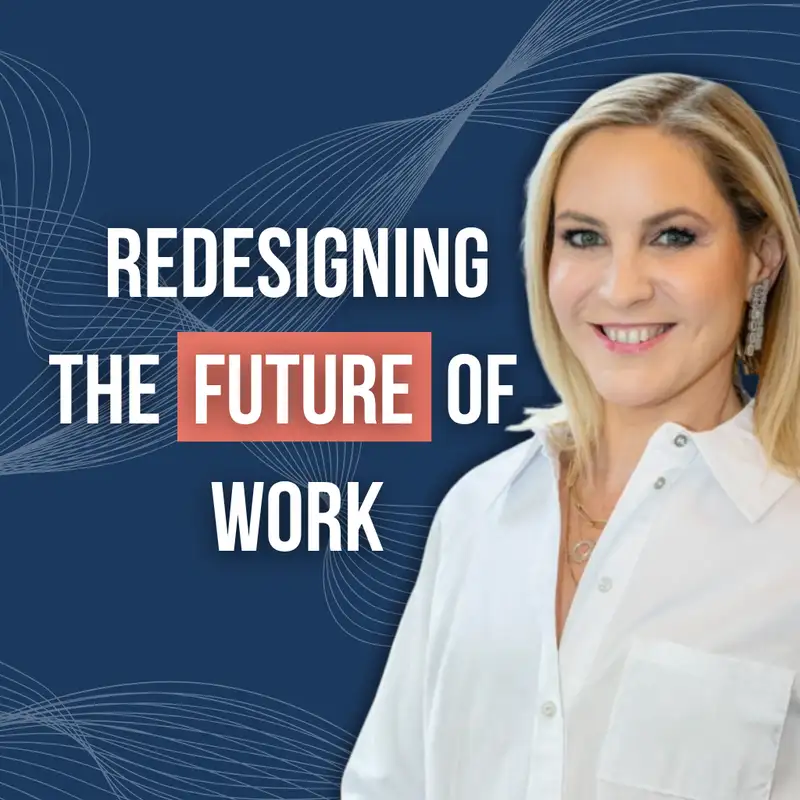
70% of Your Work Could Be Automated. What Happens Next? | Shlomit Gruman-Navot
In this episode of People Multiple, Gia Ganesh sits down with Shlomit Gruman-Navot, former Chief People Officer at OLX and Miro and co-founder of Prakti, to explore what real AI transformation looks like inside an organization. Drawing on 25 years of experience across HR, organizational transformation, and operating model design, Shlomit explains why leaders need to look beyond AI tools and usage metrics and focus instead on workflows, business outcomes, and value creation.
Shlomit challenges the traditional organizational chart as a way of understanding where work and accountability live in an AI-enabled company. As workflows increasingly move between humans and AI agents, she argues that leaders need to understand who owns the workflow, what should remain human, what can be augmented by AI, and what can be fully automated.
The conversation also examines the difference between AI adoption and genuine AI productivity. Shlomit explains why efficiency gains do not automatically translate into ROI, why AI can actually increase cognitive load when work is not redesigned, and why one of the most important questions leaders can ask is, “What have we stopped doing?”
Connect with Shlomit Gruman-Navot:
- LinkedIn: https://www.linkedin.com/in/shlomit-gruman-navot/
- Join Practi: https://community.practicommunity.com/join?invitation_token=0ece52bfb59ed763a8ea48c9d28a29d690073f72-6470e37d-4722-4495-bb23-1cae56f02f63
- Shlomit’s cohort for HR/People leaders called AI-Ready HR Leaders: https://practi-hr-leaders.lovable.app/
The discussion also tackles questions…
- How can companies tell the difference between real AI transformation and AI adoption theater?
- Why is AI adoption a poor metric for measuring business impact?
- How should boards measure the ROI of AI investments?
- What is the difference between AI-driven P&L impact and AI return on investment?
- How can companies redesign workflows around humans and AI agents?
- What work should remain human, what should AI augment, and what can be fully automated?
- Why are traditional organizational charts becoming less useful in AI-enabled organizations?
- What should leaders look at instead of the org chart to understand how work actually gets done?
- How can organizations determine whether they have the operating model required to execute their strategy?
- What should companies stop doing after implementing AI?
- Can AI increase employee workload instead of reducing it?
- How should HR leaders redesign performance management for an AI-enabled workforce?
Key takeaways:
1. AI Adoption Does Not Equal AI Transformation
2. Real AI Transformation Starts With Workflow Redesign, Not New Tools
3. Leaders Should Ask, “What Have We Stopped Doing Because of AI?”
ys Human, What AI Augments, and What AI Automates
6. AI ROI Should Be Measured Through Business Outcomes, Not Productivity or Usage Alone
7. HR Must Shift From Designing for Stability to Designing for Adaptability
8. AI Is Changing How Organizations Should Recognize and Reward Talent
9. Strong Talent Cannot Overcome a Fundamentally Broken Operating System
10. Many Business Problems Are Ultimately People Problems
Similar episodes:
- The People Decisions That Make or Break M&A: https://www.youtube.com/watch?v=wdzKjihV8BI
- The CEO Wanted a 5-Minute Layoff Call. She Said No.: https://www.youtube.com/watch?v=Wx35nZdJSXc
- The Recruiting Engine Every Growth Company Needs: https://youtu.be/s5VW1vR69Qo?si=iKUUZ14lYBKptuFU
Production
Produced by: The AGN Group
Host: Gia Ganesh
Producer: Katie Hart
Websites: https://peoplemultiple.com/
Social Media Channels:
Instagram: https://www.instagram.com/thepeoplemultiple/
Want to be a Podcast Guest?