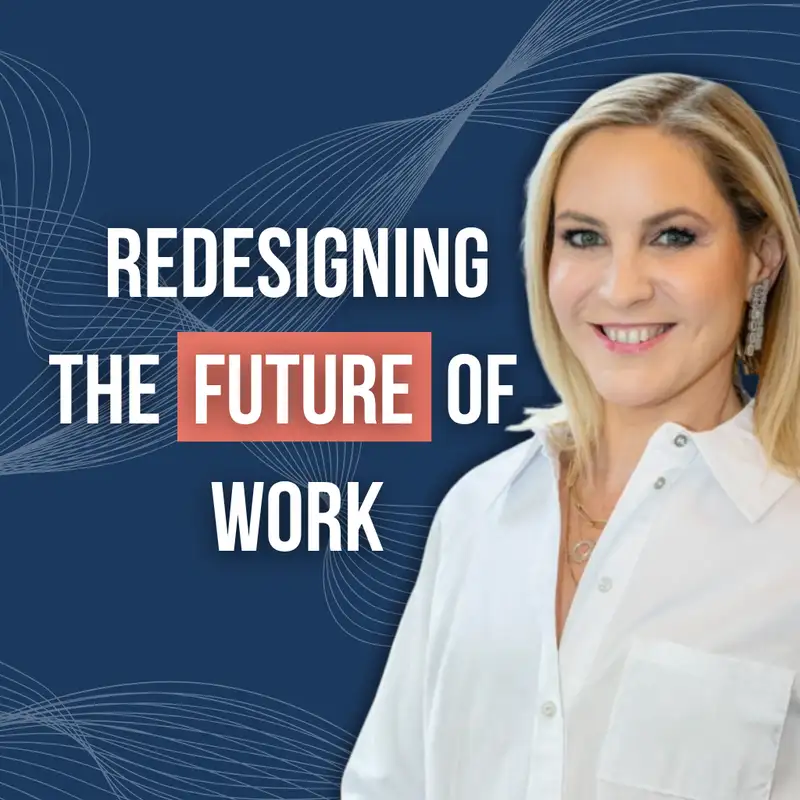
70% of Your Work Could Be Automated. What Happens Next? | Shlomit Gruman-Navot
speaker-0 (00:00.142)
If your metric is adoption, you are losing the story. Adoption tells you usage. People are using it like great, but what has moved? What has changed? What outcomes is it driving? What do we want out of it? And I think that's what I'm seeing more and more the gap is and it needs to be challenged.
speaker-1 (00:22.402)
Most companies talk about AI, and few have actually changed how work gets done because of it. Shlomit Gruman Navot argues that the org chart itself is lying to us. It can't show where an AI agent's work ends and a human's begins. Shlomit has spent 13 years as the chief people officer scaling OLX from 3,000 to 11,000 employees across 30 plus markets, then running people at Miro and now as a co-founder of Prakti.
She sees this problem play out across dozens of companies at once. Her take, operating models decide who wins the AI transition, not software. Today you learn how to tell real AI transformation from AI theater and what a board should be asking before it shows up as execution risk. Welcome to People Multiple. My name is Gia Ganesh. Here we unpack how talent decisions act as leading indicators of enterprise value, shaping whether companies scale with strength or stall under pressure. Let's dive in.
speaker-1 (01:25.742)
Shlomet, welcome to the People Multiple Show. I'm so thrilled to have you here.
speaker-0 (01:30.584)
Thank you, Gia. I'm very honored to be here with you today.
speaker-1 (01:35.222)
Awesome. Shomit, I would love for you to briefly give us your professional background history.
speaker-0 (01:43.554)
Wow, briefly. Briefly. I'll I'll try I'll try. so I've been an an HR leader executive for for many, many years. So overall 25 years working with organizations. I lived and worked in six different countries throughout my career. I worked in technology companies, marketplaces, consumer tech.
SaaS and banking. been 13 years chief people officer. Currently I live in the Netherlands, actually for the past seven years already. So I moved also to the Netherlands with work with OLX, the company I worked for. and I'm not with OLX anymore, but I am in the Netherlands, still in the Netherlands. so this is very much in a nutshell. So transformation leader, people.
HR, and now very, very passionate about AI. So my work currently focuses on advisory in areas related to operating models, work redesign, and I'm also running a community of almost five hundred professionals called Practi, which is all about where AI meets real world.
speaker-1 (03:03.16)
Love that. And I have so many questions for you. But before we get into anything that you told me, I want to start with something else that you shared. That you played the piano for 10 years. And you said that at your core, you're an artistic person, right? So 10 years playing an instrument trains you to hear things when even if it's slightly off, you can hear that. So I'm curious when you walk into an organization or you start a new consulting engagement.
Are there things that you hear or notice before people tell you that something is wrong in the organization because of your ear for you know, finding things that are wrong?
speaker-0 (03:41.25)
Music. that's a that's a beautiful question because I never thought about the correlation be between the two. and actually I have to admit my dream as a kid was to be an actress in Hollywood. So that didn't happen. although, you know, I I could argue that acting and being in the p in the people business, it's sometimes, you know, it's it's very it's very close, but no, I I didn't become an an actress.
About playing the piano and listening. well where I think it gives you more, what I feel that it gave me more is the discipline of things. of course, you know, you learn how to read between the lines and what is not being said versus what is said. And I think that this is more of a cultural I would say understanding rather than even piano background is really to understand.
High context communication, low context communication, what is said and and where. but piano and learning piano for so many years and being in competitions and playing every day for two, three hours, it teaches you some degree of discipline. That you have to continue, you have to try on. When you in a competition and you play and you in in the middle forgot something, a note, you just continue.
you never stop. You continue. Even if you made a small mistake, you continue. So I think it gave me some muscles of disciplines and also resilience to some degree, which you know, it just were very, very good foundations for my entire life.
speaker-1 (05:26.626)
Love that, you know, especially what you said in terms of reading the culture, high context, low context, reading between the lines, and you know, the discipline and resilience are all important parts of HR professionals makeup, right? You without those, you can't succeed. So I love how you shared the piano aspects that tie back to your professional journey and how they have shaped you to become the professional that you are.
speaker-0 (05:52.748)
Exactly. And it's also music, right? Like everything that we do is is is a music. and it actually connects to how I describe cultures. I always describe culture as the smell of the place.
speaker-1 (06:05.513)
I love that.
speaker-0 (06:07.126)
the music. It's like it's the feeling in the place is how does it feel here? And you know the smell of the place immediately when you enter an organization.
speaker-1 (06:17.262)
I've never heard culture described as the smell of a place. So I love that. Shlomida. you've led transformations and operating model redesign in organizations. And I believe you've been in organizations that have ranged from 500 million to three billion in revenue, right? Across different industries, highly ambiguous environments, different countries, different cultures. And you were very instrumental in scaling OLX's people.
headcount from three thousand to eleven thousand employees. That's a huge feat, right?
speaker-0 (06:52.706)
Yeah, during
speaker-1 (06:54.422)
During COVID?
speaker-0 (06:55.702)
Yes, during COVID. Which was like I would say a double challenge. 'Cause you fire and on board so many people, mostly remotely.
speaker-1 (07:04.642)
Wow. So what did those experiences teach you about people decisions that consistently determine whether an orgus an organization can actually execute?
speaker-0 (07:14.078)
You know, I I think it's all the decisions that we are making in organizations are people decisions. And what I mean by that is that what seems to be like a business problem, it very often becomes either a decision making process problem, ownership problem, or who is taking ownership or who is accountable over this decision or ways of working, or we haven't hired the right
Person for that context of what we need right now. So everything in the end is interconnected and is linked to people. So people make a huge difference because they also shape the conditions and the environment in which we operate. What I learned, and when I think about the human aspects or the people aspects, there are the conditions that we create in the organization, and these are things like how we make decisions, the management system. So are we clear about the role?
of the supervisory board, of the the management team, what is PL ownership looks like? what is end to end ownership looks like when we think about product development. Do we really manage the product end to end? Do we bring the right people into the conversation? making of shaping the product together, making decisions, iterating. So all of that is what I call how we get things done.
here in the company or you can call it trading models. And then you have the human and the human gap. so how people feel in the organization, the smell of the place, who we hire, how we hold everyone accountable in the company in terms of performance. Are we clear on expectations? are we taking into consideration fear, anxiety, uncertainty that definitely people are experiencing more and more. So
Both are so important, the conditions and the human gaps, and you constantly have to take care of both and balance both in order for the company to achieve what it wants, whatever it wants to achieve. If this is hyperscale, growth, transformation, both. We are now in the constant change era, so typically need to do everything in parallel. There is no longer like transform and perform or
speaker-0 (09:38.258)
in one area we are transforming, in another area we're just performing. It's all completely blended and you have to change all the time.
speaker-1 (09:47.286)
I love that. so I'm curious, you know, because of your exposures to so many different companies, when you step into a new company, you know, as a CPO or as a consultant, what do you look at to gauge whether the organization has the capability to deliver on its strategy before you even have time to form an opinion about the people team or the people themselves, right? So how do you decide?
This organization I believe in the i ability of this organization to deliver a strategy. I wanna be part of this organization.
speaker-0 (10:18.476)
Yeah. so I think actually it starts with conversations. You have to start by listening, for sure. I mean of course you can go through the documents, the strategy document, you can request for a lot of information ahead of time. But then and quite quickly you have to establish what is the smell of the place. so look for some patterns, what people are telling you, are there any common themes which are coming out?
Where are the bottlenecks? where decisions get stuck? Are people clear on expectations? Do everyone even speak the language of strategy? Do everyone understand? And if I'm taking just the extended leadership team, okay, I'm not even talking the entire organization, but the extended leadership team, which typically is like your top fifty to one hundred people, are they clear in the same way about where we are going and what the priorities are?
So once you have these conversations, you surface very, very quickly what are the low-hanging fruits, what needs to change, what you need to work on, what seems to be working well, which is equally important. Because you really want to maintain the things that are working well and you don't want to touch them. You want to amplify them. So every role that I entered, it started with let's talk for the first month or two, to understand the context of this organization.
And then whatever strategy you have, whatever you have on paper, great. but most important is how you're going to execute on this, right? And what are the bottlenecks and the risks that you have around execution and what are the things you need to potentially fine-tune or change or keep in order to achieve this strategy? 'Cause at the end, you know, it's all about any strategy can work on paper. Most important is how you're going to execute.
speaker-1 (12:14.19)
Correct, correct. And what do you do to evaluate the organization's ability to execute?
speaker-0 (12:21.296)
so it's first conversations, understanding what people perceive and where the organization is. I would look at how decisions are being made today. So how many levels of decisions, how many layers the organization have, so how fast decisions are moving, because that determines how fast you can move a product to the market, so time to market and how fast you can iterate.
Ways of working. How do you build any value in this company? So who do you bring together? Because typically and this is just an example from things that I saw again and again, you have this friction between product and tech and commercial.
speaker-1 (13:08.64)
Yes, always.
speaker-0 (13:10.338)
Classic and here exactly in classic. And then the commercial teams are saying product does not deliver. And product teams are saying, but commercial is not able to sell, and then you have tech in the middle. Now, of course, AI is changing that dramatically because the role's getting really blended. but that's a friction point. And then you need to look at okay, how those teams come together on a daily basis to create value for customers. So
Who is responsible? So who is accountable? Who is the DRI, the direct responsible individual? Could be a product owner, whatever. So who is the person that is bringing the team together from marketing, from tech, from commercial, whoever is needed, and is very clear on how we make decisions, how do we do discovery, how we iterate, how we move faster here. And by the way, this approach does not only apply to external products.
It's exactly how I would manage things inside the people team or in the finance team. Doesn't matter. It's like you always need to apply this product thinking in order to move fast. So I would look at decision making, how things get done, ways of working, layers, so how information flows in the company, is the information flows constantly, are there some bottlenecks, what are the rituals? So I don't know like
How often do we do all hands? how do we communicate to people, in what channels communication happens, because there is so much noise today, Slack and emails and and other tools that the company is using. So all of that matters when it comes to answering the question can we execute our strategy? And what can we do better?
speaker-1 (15:05.61)
And talking about execution, you said, you know, AI is changing how fast we can execute, at least on the technology side. And investors are starting to s price that AI leverage as well. You've said that org charts can't actually show where that leverage lives once agents are doing real work, right? If the org chart is misleading a board about where c where k capability actually sits, what should they be looking at instead?
speaker-0 (15:34.252)
Yeah. it's such an interesting question because we are in the messy middle now, so everyone's trying figure out and there there isn't like a perfect answer and things are changing on the go. Orc chart tells you who reports to whom, right? we are really living in the times of work charts where workflows, if you take any workflow, it flows between humans and agents. and sometimes between agent to agent.
Because you build an agentic workflow. And that's very much also linked to this iceberg model of what stays human, what you augment, what you automate. So the value sits in a work in in a workflow. And what you really want to get to is that you have a responsible person for the workflow. And that has nothing to do with the org chart. Because you can have a DRI, so direct responsible individual for a workflow that understands.
very well how workflows in this process. Let's take an example, customer care. I recently was talking to a friend of mine who is a chief product officer in a company, and they completely revamped their customer care process end to end. And they have now a customer satisfaction of above 95%. And they did it with Ayal, by the way. So a completely agentic process with very c clear guardrails and
been very clear on the data that is being used. But they took a workflow and they completely revamped it. and they changed the role of the product owners because the product owners can do now also the engineer work and the commercial work. So the work it's completely changed. And the outcomes are also there because they see better customer satisfaction. Now that's for me an example where you take a workflow, you have a blended workforce
in this workflow, humans are still there because they're accountable, you need judgment, you need to make decisions. So they are there in every step of the way. But really now what you're thinking about is how do you redesign the work itself, start to finish, and who is responsible for it. And that's not something you'll see in the in the work chart. So I think when it comes I sorry in the orc chart. So I think when it comes to really understanding
speaker-0 (17:56.13)
value, you need to look at outcomes. What is actually changing, which is far beyond how the organization is today on paper. And we know that there is a huge gap between how work is changing and how organizations are built still. You know, there are of of course here and there examples, especially of AI first companies, but for established companies there is still a big gap. You have to look at the at the outcomes.
speaker-1 (18:21.87)
Speak, yes.
speaker-0 (18:25.992)
and asking for questions which are about outcomes rather than you know, who is on the orc chart responsible for what. Because this person might not actually be redesigning a workflow, start to finish.
speaker-1 (18:40.462)
Curious, right? You talked about established companies and as they are all moving towards this AI forward, AI first posture. How do you actually help? I know you help organizations with AI transformation. How do you help them move? Because, for example, even at the workplace that I'm at, even moving my team, right, towards, hey, let's get more automation in and really look at our workflows. The first argument I get is: hey, the tools that we are using have AI in them, right? Like for example,
If you use greenhouse as an ATS as a system to bring people into the company, they have introduced AI into their tool. So my team now says, I don't think we need to change our workflow because greenhouse has introduced AI components into it. So we just need to leverage that, right? So I'm curious, what are some of the roadblocks you're facing when you work with companies on this AI transformation journey? And how do you help around these execution challenges like what I just described? That other vendors are now bringing AI into their
product.
speaker-0 (19:42.486)
Yeah, beautiful. you know, it that's tipi the typically it starts like this. We have the tools. Great congratulations. You have the tools. in what way work changed? And by the way, when I say work change, and this is also a question for for for board members, is what have you stopped doing? That's a very interesting question that I would what have you stopped doing? Not just what you started doing, what have you stopped doing? Because
When you redesign work, you also need to stop doing a lot of things you did before because it's not necessary. So the starting point for me is let's take it workflow by workflow. Like show me a workflow and how you redesign this workflow with the tool. So the tool is not I I won't say okay, it's not important. It's okay, it's it's helpful, but it's not about the tool. It's about the mindset. It's about the mindset of
I am going to with the help of the tool, whether it's an LLM or an HR system that now embedded AI in it, great, they have these capabilities. But how my work has changed. And it could be things like, okay, I'm saving more time. Great. What am I doing now with this time? it changed the things that I'm working on. And there are things today that used to take seven days and now they take four hours. Okay, great. So
What do how did you leverage this time? Are you creating new value? is that savings? Is that just efficiency? Or can you use it to produce something else? or or build value somewhere else? So I would really look at what is changing, and this is about mindset. And typically what I hear is that we don't know how to redesign workflows. You know, we have tools, but how do you redesign workflows? And then it's really going through
Okay, let's look workflow by workflow. Let's start with one workflow and let's redesign it start from to finish. And that in includes getting really, really clear about what stays human and some things have to stay human. Because even if you are using greenhouse or any other, let's say recruitment tool, you have to make sure that there is no bias in this tool. You have to make sure that what you told the tool to do
speaker-0 (22:03.816)
is giving you the right result. So you always did you need to be there in every step of the way. Or when you go into an interview, yeah, you might have a note taker, an AI note taker. I go to all my meetings with a note taker, but I always read the notes afterwards and I summarize myself. So that's an example of augmentation. And then there are things that of course you can give to AI fully to automate because it will do it faster.
like screening, like going through a lot of like resumes, but you need to make sure that you gave AI the right request. and that you check that it's it doesn't have bias, that it makes the right choices. So you really need to be clear about what stays human, where AI can really help you to synthesize, makes better decisions, bring a lot of data points together. So where augmentation happens,
And what you fully automate to AI. And when leaders are saying, I don't know where to start, I always select two things. Start with the with the workflow that annoys you the most. So pick any workflow that is really painful for you, and pick something that really makes a difference, that is really important right now based on your own function and company priorities. So where you think you can move the needle, go there.
And then see what happens. So you go workflow by workflow. And then you start seeing how it changes also your mindset and your work around it.
speaker-1 (23:37.61)
I love the question that you ask. What did what did you stop doing because of this change? I think that's very, very important and a critical question to ask. So I'm curious, right? Board boards want to see some kind of efficiency gain or you know, they want those AI adoption to show up in numbers on the PL, right? How do you what do you have to say to that situation? Because I think, like you said, many of us are in the messy middle.
I don't know if it can show up on the P N L right now. So what do you say to boards that are asking for a fast result?
speaker-0 (24:14.764)
Yeah. So I I would start also by saying that PNL impact does not equal return on investment. And what I mean by that, you you might be seeing some impact on the your PNL. so you know, new products, or again if you have better customer service, you'll see better metric customer metrics that might impact revenues, you or you might have some efficiency gains.
But when you think about return on investments, you have to take into account the spend. So everything that goes into building with AI, like tokens, licenses, whatever. So you have to also separate the two things PL impact and return on investment. And you have to look at both critically. So this is kind of overall how I I would think about it. In terms of efficiencies, it's I understand why.
it's on the surface always to ask for more efficiencies because it it's just logic. If something that took you one week you're doing it now for four hours, or if there are things that AI is doing in full because you automated this completely, of course you can expect efficiency gains. I think it's it's very normal. Another question if that should lead to restructuring to reduction, that's a different question. Because
You know, it also gives the the company an opportunity to reimagine what they can do more, right? Or to think about the value that they create for for customers. So it all depends again on what is the end goal and what for. So why? Why should I use it? If you only use AI for efficiencies, then you're a little bit losing the point because I see now companies are letting people go. They're letting people go not because of AI, but because they overhired some years ago.
because they have inefficient processes and we know that this is not because of AI. and actually I hear more and more about the works the workload that is increasing as a result of AI. Because now you have to check output, you have to check work slop. You know, I was just talking to this person the other day and they said they're spending six hours more every week to check the agent's output.
speaker-1 (26:36.939)
gosh.
speaker-0 (26:38.136)
And that goes to the point of what you stopped doing, because if you haven't stopped doing anything or you didn't reprioritize, you know, it might the the the workload might increase. So I think adoption, just generally, if your metric is adoption, you are losing the the story. Adoption tells you usage, people are using it at great, you know, and many companies are giving everyone clothed code.
or Gemini or Copilot or several tools at the same time. And they see increasing usage and in adoption. That's great. But what has moved? What has changed? What outcomes is it driving? What do we want out of it? And I think that's what I'm seeing more and more the gap is and it needs to be challenged.
speaker-1 (27:30.798)
Again, you know, you you I think you described this as an iceberg framework where you split the work into human augmented work and then automated layers, right? So when when you've seen organizations or functions get that correctly, what kind of value was unlocked for them?
speaker-0 (27:47.566)
I've seen some times where by thinking through this framework, you moved 770 so 70% of your job, your work to AI. Because you could automate 70% of your work. Now, I have to say that this is more in operational and transactional processes. it also depends on what kind of workflow, but definitely once you apply.
apply this framework, you could unlock so many opportunities on the automation part that you could not before. So it this is all part of take the workflow and think, okay, what can AI, what you can fully automate now to AI because it's gonna save you time, not necessary. That's you it's gonna do a better job. definitely. Great, you move it there. And then
Where it makes sense to augment, and and and keep it fully human. And once teams went through it, like really thinking through this framework, they found that there is so much that they can automate. And then comes the question of letting go. I'm going to let go. And of course, if we think again about the human gap and the condition gap, there is a lot of fear that comes with it. If I'm gonna let, you know, this work to AI, what is my job? And that's that's legitimate.
but the reality is that in some areas and some workflows you can unlock a lot of potential for full automation.
speaker-1 (29:23.2)
It it sounds so idealistic. I I haven't yet seen it. I can't wait to get there. you know, so it feels a little like hard to get there situation.
speaker-0 (29:33.59)
Yeah. And and you you mean specifically the f the seventy percent automation?
speaker-1 (29:38.082)
Yes, seventy percent automation. Yes, that one.
speaker-0 (29:41.19)
it's and as I said, it's more for what I've seen at least, you know, so from my experience, it comes down to more operational activities. Right. So not necessarily to work that requires more judgment, so a lot of context goes into it. Yes. But if we think about it today and the technology is is evolving as we speak, and more and more you can automate to AI. And
Actually I think that what sometimes stops it is it's some inertia. Inertia that you have also in organizations, let's face it.
speaker-1 (30:20.128)
Yeah. Absolutely. Absolutely. you know, you just spoke about an example where somebody said they're spending six additional hours checking the AI's work, right? So I feel like how does an investor or board tell real AI productivity from adoption theater, right? Hey, I'm using AI. He's a company, there's ninety nine percent adoption. But
What is the productivity gain we got out of it is still undefined because I'm spending more time checking the work that AI did. So there's not truly a productivity gain. Should we even be focused on productivity gain? You said that we should be focused on return on income. What does that ROI look like? What should we be thinking? How should we be thinking about ROI?
speaker-0 (31:02.146)
Yeah. I I think it's a beautiful question in in the sense of what is productivity and should we measure productivity? I I have to say that even before this all AI era, when people were talking about productivity, I wasn't sure like okay, how do you really measure productivity for certain jobs at least? I mean, of course, there are jobs who are more related to productivity, like sales.
Okay, so sales you can measure how how many sales you you did, right? or how many customers you called, or with how many customers you interacted. So it's it's easier to measure. or in a call center or recruitment, right? I mean, it's also like with how many candidates have you interacted, how many roles you closed, time to hire, time to fill. So you have some measurements around it. And then you have professions like.
product and tech. others were how do you really measure productivity? Right. And I don't think anyone found the silver bullet for that. And now I hear again about this productivity. And there are so many things that comes down to with the AI usage that it's not about productivity in my view. It's about value, output, outcomes. I can send out this from my own experience. I've been
working only or immersing myself completely with AI for the past year and I have agents and I have assistants. I sometimes work much harder. Although of course, you know, it's the it it helps me think and synthesize and I'm a heavy user of AI, but I can see the cognitive load. I can see how much I can take from you. and you have to check the output and you have to be like
very, very strongly in the loop from a judgment point of view for everything that I send. You know, I make sure that I always go through it. Or I give it the right context. Or where I open a project or where I use a skill or where I go to clot code. So I also need to decide the use case, what makes sense. It's also work. And at the end my question is always, okay, what are you getting out of it? So
speaker-0 (33:24.684)
the productivity, this or work with AI needs to be translated to we change something for the customer. We changed something in the organization. our speed is now very, very different. Our value. So something that you can really point to, which is not about this adoption theater or usage theater, but outcomes. And really look at outcomes. And that's at the end what is important.
And maybe also token usage is not that important. You know, it's if it gives you results, great, then spend more tokens. You know, what is the right number of tokens? I don't know. but it really the question, are you delivering different results?
speaker-1 (34:12.088)
I love how you put it, Shlomit. So question for you, right? Now all of us are supposed to think in terms of outcomes, capabilities, and you know, the value that we can deliver through AI and humans, right? So which means the way we work changes, the way we should set goals and objectives, the way we reward people, the way we plan for career growth, etc. All that changes structurally, fundamentally.
What have you what are your thoughts on that? How should it change? What should we be thinking about as a people leader? How should I think about changing some of the fundamental ways in which people set their objectives, perform and then get rewarded?
speaker-0 (34:55.234)
For years we had to design for stability. What I mean by that is that we built system for transparency, consistency, predictability, grading, so examples like grading, and levels and and job architecture and a very clear performance management, because that was very much needed and that helped a lot organization scale. Because you needed a system.
And the system needed to be clear. Now our job is to design for adaptability. It's very different. It's a very different world. So we are moving from designing for stability to designing toward the adaptability. And that requires HR leaders to change quite significantly themselves. So mindset to it. And what I'm and what I mean by that is that everything becomes fluid. Jobs
become fluid, skills become fluids. you have to really apply this product thinking in everything that you do. You constantly have to iterate and experiment and build because this is so easy also today to take something from a prototype to execution, get feedback and move on. All the elements of the system need to change around that. And I'll give you the example like jobs, right? If you had a job descriptions in the past,
What is a job description today? The jobs are changing as we speak. Skills are changing, the requirements from the job. so all of that to say is that we have to adapt the systems around it. And I think some things are still, you know, it's this is go back to basics, right? You you need good leadership, you need good management, good managers do make a difference. even in the AI adoption era.
you can see the difference between better managers and worse managers. So better managers are those who care about both the human and AI and they integrate this well together. So you still need all of that and you need leaders who lead by example and showcase and talk openly about their usage of AI and where they tried and fail and be vulnerable and be open about it and create the conditions for the company to try and experiment.
speaker-0 (37:19.606)
And you need very clear incentives for people to understand what is important and these incentives need to be linked to the company's priorities. And then yes, you need a performance management system. What needs to change is how you run these things. And if I think specifically about performance, it needs to be continuous. These like long cycles don't work anymore. You can't wait
A year, you can't even wait six months. You have a conversation and you adjust something in the goals. It happens every day. So everything needs to be continuous. it it needs to be on the go, it needs to be fluid, the systems need to reflect that. AI can help us to synthesize a lot of data, a lot of feedback, so that the conversation between the people leader.
And the employee becomes much more effective. And we that's where we have to leverage AI much more to make all these processes much more human. It's kind of funny. AI can help us to become more human. Technology to become more human. And help us to run these things in a much more timely manner. and then some things are they're not they're never gonna change because we are humans.
And we need that clarity.
speaker-1 (38:49.434)
I know many people leaders struggle with people constantly asking for more compensation, more promotions and I want growth. And now, like you said, everything is fluid, right? Now, today I could be a junior engineer doing things that are four levels above what I can do because of augmentation through AI, right? So then truly am I a the leveling system goes away, which means
my pay grades and my salary bans go away and how we compensate people goes away. So there's a whole I think we need to as people leaders rethink how to reward and measure performance. I that's something I feel very passionately about is how do we get to this new way of thinking around what growth looks like for employees and what what gets replaced in terms of titles, levels, promotions, grow more money, more rewards, etc.
speaker-0 (39:42.028)
Yeah, absolutely. And you know, this is not necessarily new, but this is this all aspect of skill based compensation. So how do you compensate people for their skills, mindset, what they do, right? and it's a very different view because traditionally you had like that's the job. You're in the job, that's the level. You know, if you wanna progress, then you have to be promoted.
To the next level, and many people wanted to become managers because of that, like not needed. so now you have to look at the organization from the lens of who brings value. So who is the workflow DRI? Who is the person that is redesigning the work with agents, with humans? And you need to make sure that you you know of these people and you reward them correctly.
Absolutely, because it's all value skills based, value based mindset, which is extremely important. You want people like the the best adopters of AI, or I would say the people who actually change the work with AI, they're optimist, they have agency, resilience, agility, all these things that you wanna you wanna see more of in the organization. So
You and that's what I meant by designing for adaptability, you need to make sure that whatever system you have, you are able to see those people and retain them and reward them because they're the superstars that are make a difference in in your organization.
speaker-1 (41:21.826)
You mentioned framework several times in our conversation. What is the framework that you would like all of us to adapt? If somebody was embarking on an AI transformation, right, what are the four or five steps or ways of thinking or ways of executing they should be thinking through? you know, that's what I will call loosely as a framework in this context.
speaker-0 (41:43.874)
Maybe summarize. So it's maybe bits and pieces of different frameworks, but I would definitely start with like start with yourself, first of all. Well no matter where you are in the organization, if you are a leader of big if you are in C level, a leader, but start with yourself. So redesign something around you as a person.
speaker-1 (41:48.418)
Yes.
speaker-0 (42:10.09)
You have to, I mean, I just wrote about it on LinkedIn several days ago, about this all we are all becoming ICs. That's a that's again a mindset to apply. because every IC now is a manager and every leader can it's okay. We have to become ICs. So you have to get really, really close to the work and start by redesigning or building something on your own. and it it could be build your own board of directors, build your own chief of staff, whatever. Just do it.
redesign something that really annoys you or is important. Take a workflow and redesign it. Could be as small as as possible, but just do it. So start with yourself. and then if you're approaching something at the company level, then again apply like this this logic of what makes a difference, what annoys you, but then take it and break it into where is where is
I need to be there as a human or where a human needs to be in this process. Like what are the decisions that need to be made? The accountability, the judgment, everything. Just map it out. Like literally just write it down. like if I take, I don't know, let's take performance management process. There needs to be a conversation between the manager and the person. Yes, that's a human thing. Extremely important.
We need to make decision, the final decision on someone's performance assessment. Yes, that's a human decision. We need to clarify expectations, that's a human decision. So it's almost like take the process and map all the touch points where you would never delegate it to AI. And then also on the other end, put all the things that you should not be spending time on it or anyone should be spending time on it, because AI can do a much better.
faster job in doing it. And then there is the in-between, like the augmentation. Like what data AI can help me to get or synthesize so that I can make a better decision? Or if I got something from my global team and I have a business unit that I support, can AI help me to identify gaps? So there is the translation problem. Like like global wants something, I have my own business unit or country
speaker-0 (44:29.024)
Let's put some context, let's have a conversation with AI, let's put some contents with the right prompts, and then see where the gaps are so that I can be better equipped and ready to have a conversation with my leaders. So things like that where I would really take it and break it and really look after my mindset around it.
speaker-1 (44:51.278)
I love that. So we've had this very interesting conversation around AI so far. I want to step away from AI specifically. So of all the people decisions that a leadership team makes, right, which ones have the greatest effect on a company's ability to grow, execute and adapt? What do you think?
speaker-0 (45:10.39)
of course who you hire. because I've seen that you know someone can be very, very successful in one environment and not successful in another, and that's okay. So who you hire, for what context you hire, context is most important.
speaker-1 (45:12.299)
Well stop
speaker-0 (45:35.712)
Like, do you need change? Do you need transformation? Do you need growth? Do you so what is the what is the context here for whom you are hiring or promoting someone? So definitely hiring and pr and promoting. as I mentioned before, everything that is related to how work gets done. So decision making, rituals, ways of working, accountability, ownership, expectations. So I would really look at
How did we organize things here so that people can thrive and not survive? Because a lot of people in the organization are surviving but not thriving. And you want them to thrive because then the company will thrive. So I would look at these like people decisions, like hiring, who you are letting go, when you are letting go. Are you hiring for the right context? Promoting the right people based again on the context of what is needed? What have you integrated into this thinking?
Have you looked at mindset even more than experience, which is extremely important? And then how we organize the work here so that people can actually get things done.
speaker-1 (46:45.806)
I love that and I agree with you. I think what you said, who you hire full stop literally changes anything and everything about the organization. So I love that. How do you tell the difference between a genuine talent problem and a problem that's caused by unclear structure priorities or broken operating model?
speaker-0 (47:05.624)
the the challenge with bringing very strong any talent, I mean, but definitely a very what you would call a strong talent or someone would s call a strong talent into a broken system is that the system will get the person out faster than the the the person will be successful. So i you have to look at both at the same time. and if you have a broken system that starts from the top
No matter who you're gonna bring, the people are gonna get frustrated, not gonna be successful, will not be able to make any difference, and might leave or just be there, but not able to do much. so who you put in what roles and how you set up expectations and how you drive change all throughout the organization makes the biggest difference. So start with the top.
Really, and what's happening there? Start with the top. Always. You know, that's what determines everything. it's still the way it is, right? I mean, of course, a lot of good things can happen from the middle, definitely, and you can impact a lot of change and innovation from the middle. You can frustrate so many people if the top doesn't work and or if the management system is broken or if decision making is broken. And
Even today I hear con continuously hear this thing about trust, that how much trust is broken in organizations because and sorry that I'm ringing again the AI example, but it's like even if please even if companies that say, like we gave everyone this enroll and experiment and try, and people say, Okay, we do it, but there are still all these like ten levels of approvals for everything.
And the ways of working is not changing, so we don't trust it. As simple as that. Or that just like there is not much of a human relationship or attention to things. You know, it's like I always disphrase like that I love clear is kind. You have to be clear with people and kind, definitely, and say things as it is in but in a very, very kind way. and that's not always the case. And there is sometimes leaders are missing this.
speaker-0 (49:30.25)
human connection and human touch to people. So no matter any, we spoke a lot about AI. And at the same time, above everything, is the human, is the is still, we are humans, right? And we want to thrive, we want connections, we want to work in organizations where we can fulfill ourselves and feel that we matter and that the organization cares about what we do and cares about us as people
So let's not neg neglect that and that can impact a lot what is being done.
speaker-1 (50:05.836)
That reference to the radical candor framework that you made there, with clear and being kind. That's the basis of good management, leadership, everything.
speaker-0 (50:14.412)
Yes, exactly. Go back to basics as a sense. Back to basics.
speaker-1 (50:20.108)
And so if you could ask CEOs or boards one question whether for them to determine whether the people's strategy is actually strengthening the business, what would that be?
speaker-0 (50:32.174)
So I would definitely look at where and and this is this is actually I I was thinking about it because I was reflecting back on what decisions seem to be business decisions but were actually people or talent decisions. And one of them which for example, when you decide to go into a market or not. So you say, Okay, let's go into this market. If we are expensive this is just example. And then
You look at all the research or the data that you have and what's happening in this market, and you decide to go there and then what really makes a difference if this market is gonna fly or not is the person you put there. And very often we are attributing it completely to external factors. The market did well. Or it was like, we had a good playbook.
Which could by the way be the case, of course. or you know, we had a good product that all of that is true. But really what made a difference in all the cases that I've seen is who started this work in this market, who did we send, who did we hire, who did we this market? And that's really what made the difference. So you have to look at who made a difference in the organization and why.
And if I'm at the board, I would really go into it. Okay, let's let's look at and I work with organization now, which is like it's there they have a lot, a lot of challenges, let's put it this way. But they have pockets. They have pockets where things are working differently. And they have pockets where, for example, the leader created a culture of end to end ownership or where end to end product development.
And this is just happening in this corner of the organization. It doesn't happen in other corners because it's not part of the system. It's the leader who made it happen. So very quickly, this corner becomes the showcase. So look for these corners. Look for these corners where something is working differently there and why, and you'll discover very, very fast it's the person. It's the person
speaker-1 (52:46.392)
Yes.
speaker-0 (53:00.758)
What they do. And that goes with going entering a market as I mentioned before, or building something, or or changing, doesn't matter. So one leader can make a huge difference in the ecosystem and in the results.
speaker-1 (53:15.746)
That's a great example and you reminded me of a personal example as well where we were trying to go into a market and several of the people that we sent there, you know, were not the right people. So we failed in the market, but it was truly because of the people. And then when we found the right salesperson there, things changed, right? So that's a very good example.
speaker-0 (53:37.966)
Precisely.
speaker-1 (53:40.108)
Well, this has been fascinating conversation. but I wanna move us along to the rapid fire section, Shlomit. so you ready for rapid fire?
speaker-0 (53:50.51)
I'll give it a go.
speaker-1 (53:51.988)
Okay. One AI use case you'd bet on and one you would avoid entirely.
speaker-0 (53:58.218)
use case. So anything that is at a little bit broader, anything that is repeatable, I would bet on AI completely. So any work that is today like sending emails, messages, synthesizing, whatever. AI. Anything requires a conversation between our two people
I don't ba this is not a for me an AI use case.
speaker-1 (54:29.102)
That's a great way to think about it, yes.
speaker-0 (54:31.49)
Yeah, anything that requires human stays with humans. Full stop. Hm.
speaker-1 (54:37.998)
Prakti exists today because of a problem you kept saying. Name it in one sentence.
speaker-0 (54:43.576)
A lot of hype and people don't know really what matters.
speaker-1 (54:49.306)
One habit you had that you tell your former self to drop.
speaker-0 (54:55.085)
Overthinking.
speaker-1 (54:56.85)
Okay. and then last one here, one belief about people's strategy you think business leaders should reconsider.
speaker-0 (55:05.676)
that you have business problems. You typically have people problems. Always so always look for the people aspect.
speaker-1 (55:10.871)
I love that.
speaker-1 (55:14.69)
I love that. I wish I wish you could tell everybody this a a million times. Yes. And then this is my signature question, but I think you answered it. So I will ask it again in case you have a different example. Shlomit. What's a talent decision that changed a business outcome that no one in the room recognized as a talent decision when it was being made?
speaker-0 (55:34.05)
Hmm. So I yeah, it I I answered this question with the example of going into a new market. but I have so many examples of that every day. You know, when it's another one that comes to my head also when we looked at a certain city and we saw that in this city sales are dropping and then it turns out to be that it's because people were leaving. We had attrition.
speaker-1 (55:38.398)
Of yes.
speaker-0 (56:03.648)
And then it turned out because there is a you know not a very good manager, and people are leaving this manager. So once we kind of started like, you know, people analytics is all about the business, it's not about HR, right? So it's just about the right insights based on the data. But once we started asking questions, it turns out that this customer attrition problem, which impacts results, obviously.
Is really a talent problem. And it's once we fixed that, we started seeing completely different results, more retention. It became easier to hire people into this team. People start people started feeling more successful as well. And then results changed. So always look for the people aspect.
speaker-1 (56:54.968)
Thank you. I have had so many aha moments throughout this conversation, Slomit. I truly appreciate all that you've shared with us. Thank you so much for joining me today.
speaker-0 (57:04.398)
Thank you very much for having me.
speaker-1 (57:08.888)
Thanks for listening to People Multiple. If you found today's conversation valuable, don't forget to give us a 5-star review and share it with a colleague or fellow investor. And don't forget to follow the show on Apple, Spotify, or wherever you get your podcasts. Follow us on social media using the information on the screen and in the show notes below. This has been a production of the AGN Group. I am Gia Kanesh and I'll see you next week as we continue to explore how talent shapes multiples.